
Just a short time after MiCA became fully operational, the European Commission is opening the door to revising the rules as early as 2027 — to capture stablecoins from third countries, tokenization, and decentralized finance.
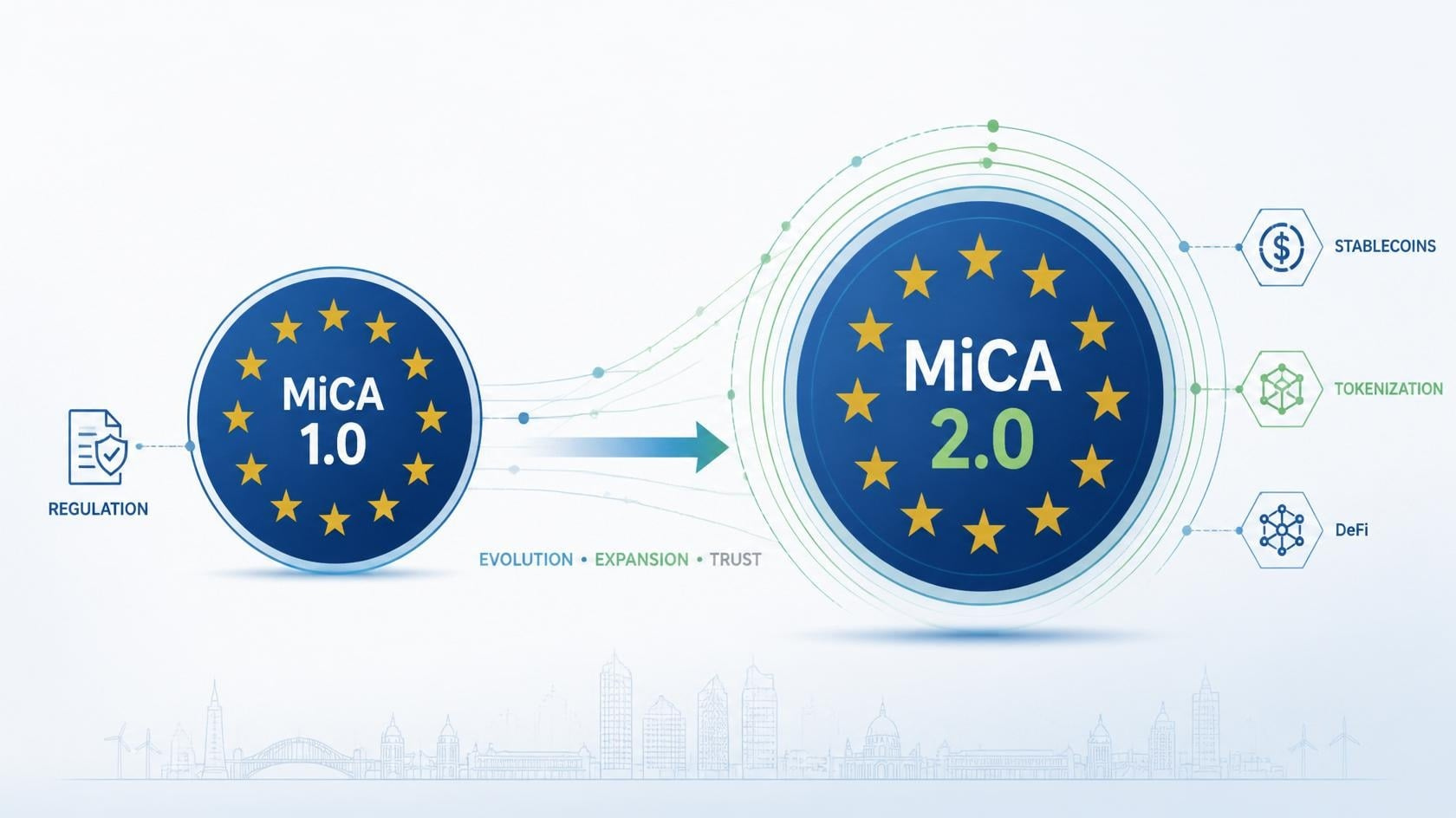
This is an AI-generated illustration based on MiCA 2.0 as a conceptual idea (Kaupr).
The trigger is mounting pressure from stablecoin issuers outside the EU/EEA, the growth of tokenized securities, and a new position paper from the European Parliament calling for clearer rules on decentralized finance, staking, and NFTs. For Nordic and Baltic companies that have just spent the past year securing MiCA licenses, this is a signal that the rulebook is not finished. The same license that today opens the single market to stablecoin issuers and crypto exchanges could, within a few years, need to be extended to cover far more activities than companies originally sought approval for.
MiCA does not currently specifically regulate stablecoin issuers outside the EU/EEA that nonetheless operate in the European market. That has become a growing problem since President Donald Trump signed the US GENIUS Act last year, which gave dollar-based stablecoins in the US a regulatory framework. Around 95 percent of all stablecoins worldwide are currently pegged to the dollar, and Trump has been clear that he wants to use stablecoins to strengthen the dollar's role in international payments.
Meanwhile, total stablecoin transaction volume has grown sharply, up 72 percent in 2025 to roughly $33 trillion, according to figures from Artemis Analytics. The European Commission is accepting input from market participants until September 30 as part of its assessment of whether to reopen the rulebook.
On Tuesday this week, the European Parliament adopted its own position paper on digital assets, titled "Digital assets – challenges for the competitiveness and integrity of the European Union's financial system." The vote represents Parliament's formal political stance on the path forward, but it does not amend MiCA directly and creates no new legal obligations for crypto companies on its own.
The paper calls on the European Commission to assess whether activities such as decentralized finance, crypto lending, staking, and NFTs should be brought more clearly within the EU's regulatory perimeter. DeFi lending raises questions tied to shadow-banking risk, while staking and yield products touch on disclosure requirements, risk management, and consumer protection. Parliament also warns against individual member states developing their own national approaches in these areas, which could weaken the single market MiCA was meant to create.
Another topic in the consultation is tokenized securities, which currently fall outside MiCA and are governed by existing EU securities rules. According to figures from RWA.xyz, there are now roughly $2.16 billion worth of tokenized stocks on-chain, up nearly 45 percent in the past month alone. Several exchanges, both inside and outside the EU, have begun offering this type of product.
The European Central Bank unveiled its own payments strategy at the end of March, including two new network infrastructures called Pontes and Appia, designed to prepare the institution for tokenization and distributed ledger technology.
While Parliament is calling for stricter rules on unregulated parts of the crypto market, the tone is far more positive when it comes to euro-denominated stablecoins issued under MiCA. According to payments company Decta, the market cap of MiCA-approved euro stablecoins has risen 128 percent over the past year to nearly $674 million, driven by EURC from Circle, EURCV from Société Générale-Forge, and EURI from Banking Circle. Trading volume for the same tokens has grown more than 43 percent over the same period.
Parliament's report frames regulated digital assets as part of Europe's competitiveness strategy, noting that a larger market for regulated euro stablecoins could give banks, brokerages, and fintech firms in the EU more on-chain settlement options and reduce reliance on dollar-based stablecoins.
With the consultation deadline on September 30 and any legislative proposal not expected until 2027, this marks the start of a long process rather than an immediate change to the rules. But the direction is clear: MiCA was written before third-country stablecoins, tokenized stocks, and DeFi seriously challenged Europe's financial system, and the EU is now signaling that the rulebook needs to follow the market — not the other way around.
Sources: Euronews, Finance Magnates, The Block, Cointelegraph
Get unlimited access to news articles and a Nordic community via Kaupr Member (free membership)
You have read what you can read for free. With an account you get unlimited access to all news and articles on kaupr.io — and become part of the network of investors, professionals and builders following onchain finance.

