
Bitcoin touched $70,000 on Wednesday for the first time since 2 June. Doubled Treasury bond buybacks, a crypto meeting at the White House, a new SEC proposal and a technical breakout hit the market at the same time and triggered forced closures of short positions.
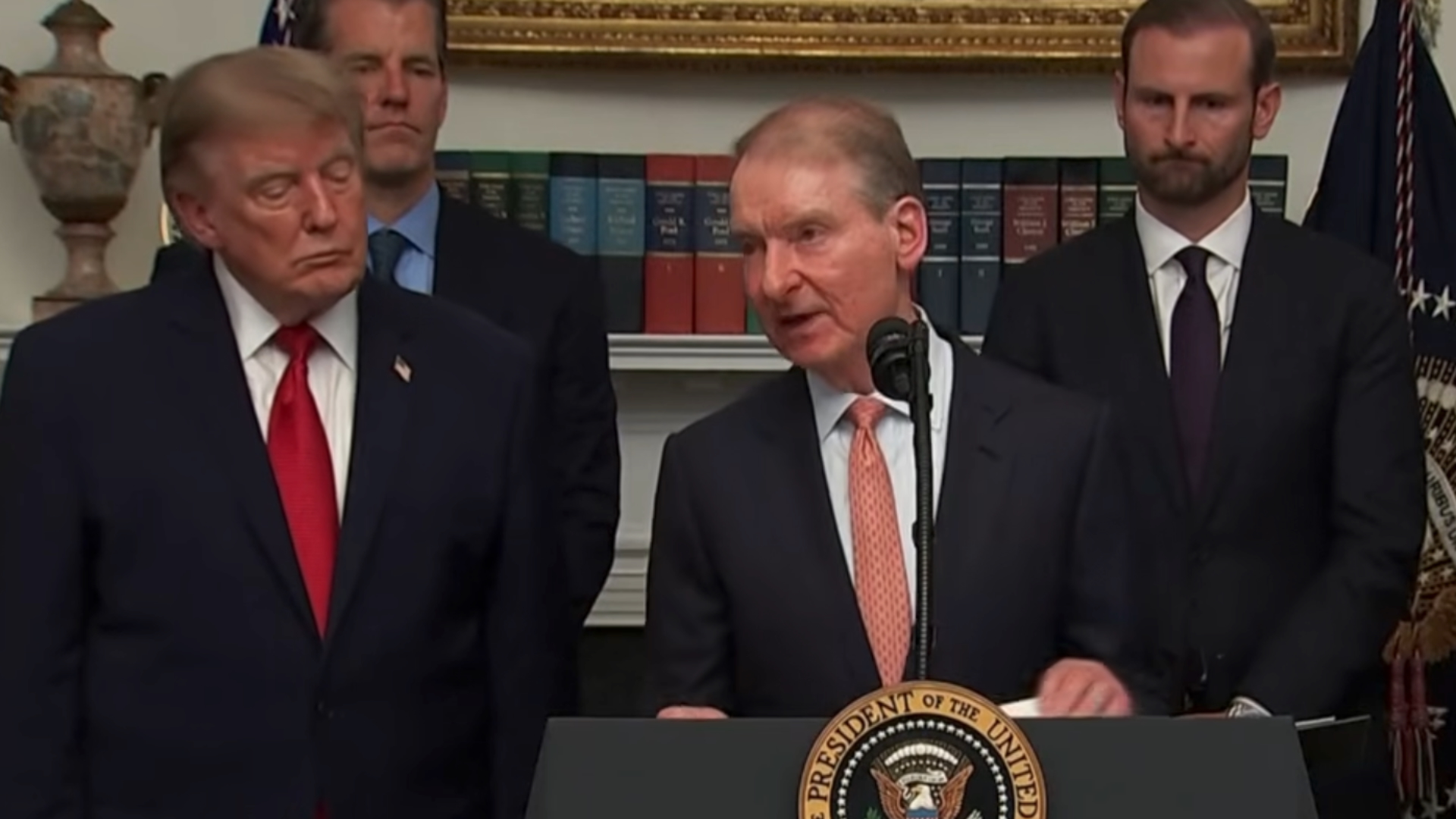
Caption: SEC Chair Paul Atkins (centre) speaks after the meeting President Donald Trump held with the crypto industry and financial regulators on Wednesday.
Bitcoin broke out on Wednesday from the trading range it had held since the June lows, rising from around $64,100 to above $69,000. On some exchanges the price briefly reached $70,000, according to TradingView data from Coinbase, for the first time since 2 June, before falling back. Bitcoin remains well below its peak of more than $126,000 in October last year.
The regulatory groundwork had been laid in the days before: the SEC put forward a new rulebook on Tuesday, the CFTC had convened its first innovation meeting, and the meeting between the crypto industry and the White House was already scheduled. Traders, meanwhile, had spent all of August watching a technical level around $66,600. When the US Treasury doubled its buybacks of long-dated government bonds on Wednesday and yields fell, the price broke through that level, and forced closures of short positions amplified the move.
The trigger itself came on Wednesday, when Treasury Secretary Scott Bessent announced that the department would at least double the size of its buybacks of long-dated government bonds. The maximum size per operation in the 10-to-20-year and 20-to-30-year segments rises from $2 billion to at least $4 billion, effective 9 September through 4 November.
The department says the increase is intended to provide greater liquidity support in the long-dated segments, where market participants have consistently offered far more debt than the Treasury has been willing to repurchase.
Yields fell immediately. The 30-year yield dropped to around 5.19 per cent after peaking at 5.34 per cent on Tuesday, its highest level since 2007. The 10-year yield fell to 4.65 per cent, and the gap between the two- and 30-year yields narrowed sharply. Investors read the move as a potential backstop for liquidity in the US Treasury market, which is worth more than $30 trillion.
The measure is not quantitative easing, however. Central bank asset purchases create reserves and expand the Fed's balance sheet, while Treasury buybacks are primarily intended to improve liquidity in securities already issued. The debt burden does not shrink.
The buybacks came on the same day that US national debt passed $40 trillion. Around $32 trillion is debt held by the public, while the rest is Washington owing money to its own federal accounts, including trust funds. The debt has more than doubled since Trump first took office in January 2017, and the most recent trillion was added in barely five months.
Interest costs are at the heart of the problem. The Congressional Budget Office estimates roughly $1 trillion in net interest expense in fiscal 2026, and that the figure could approach double that by 2036 under current law. At the same time the government must refinance maturing debt and borrow more to cover fresh deficits. Higher rates make refinancing more expensive, which widens the deficit, which sends the government back to the market to borrow still more. Debt held by the public already stands at around 100 per cent of gross domestic product.
For the bitcoin community, a number like that writes the advertisement itself. The argument is that bitcoin has a programmed cap of 21 million units, while no comparable limit applies to how much debt a government can issue, or how many dollars are ultimately required to finance it. Every debt milestone therefore feeds the case for bitcoin as scarce, non-sovereign money.
Trump left the door open. Asked whether the US might buy larger amounts of bitcoin, he said the idea had been discussed and that he would listen to advice from Atkins and his team.
"It takes a lot of pressure off the dollar. It's been very, very good for the dollar," Trump said.
That is not a promise to buy on the open market. The existing strategic bitcoin reserve consists mainly of bitcoin the government has seized in criminal cases, and officials have been tasked with exploring budget-neutral ways to expand the holdings.
Later the same day, President Donald Trump met leaders from the crypto industry and technology companies, alongside SEC Chair Paul Atkins and CFTC Chair Michael Selig. Attendees included Coinbase chief executive Brian Armstrong, Ripple chief executive Brad Garlinghouse, Robinhood chief executive Vlad Tenev, Kraken chief executive Arjun Sethi and Chainlink Labs chief executive Sergey Nazarov. Gemini founders Cameron and Tyler Winklevoss also took part, as did Nasdaq chief executive Adena Friedman and Jeffrey Sprecher, who heads Intercontinental Exchange.
Trump urged Congress to take the next step and pass what he described as a fair version of the Digital Asset Market Clarity Act. The bill has stalled in the Senate amid a dispute between Democrats and Republicans over ethics provisions, partly tied to Trump's own interests in the sector. The president reported earning $1.4 billion from crypto and memecoin ventures in 2025.
The Senate is due to hold a procedural vote on 15 September. Banking Committee Chairman Tim Scott said at the SALT conference in Jackson Hole on Tuesday that the bill has a good chance of advancing in September.
"There's no question about the fact that this will become law. The only question is how do we get it to the finish line, and when does that happen," Scott said.
On Tuesday, the day before the meeting, the SEC put forward a proposed rulebook called Regulation Crypto Assets. It would create a tailored regime for securities offerings where investment contracts involve crypto assets, building on the interpretive guidance the regulator issued in March on how US securities law applies to crypto assets and transactions involving them.
At its core are two exemptions from the registration requirements of the Securities Act of 1933. The first is a one-time exemption for offerings of up to $5 million over four years. The second allows up to $75 million per twelve months. Both require issuers to give investors a principles-based description of the business, and issuers under the larger exemption must also provide financial statements and report on an ongoing basis.
The proposal also includes a conditional safe harbour from the term investment contract in the definition of a security under the 1933 and 1934 acts. Where the conditions are met, the crypto asset is not treated as subject to an investment contract for those purposes. The rules would also pre-empt state registration and qualification requirements, both for offerings under the exemptions and for certain secondary market transactions.
SEC Chair Paul Atkins says the proposal is meant to give entrepreneurs and market participants clear pathways to raise capital within securities law while Congress works on a lasting framework. Under the proposal, the safe harbour can apply once an issuer has completed, or permanently ceased, all the essential managerial work the company promised to carry out under the investment contract. The regulator says the aim is to reduce the incentive to operate offshore and to widen investment opportunities for US investors. The comment period runs for 60 days from publication in the Federal Register.
The derivatives regulator CFTC moved the same week. The day after the White House meeting, its newly created Innovation Advisory Committee held its first session, with crypto regulation, the use of artificial intelligence in finance and prediction markets on the agenda. Selig said at the White House that financial innovation is moving fast and that the agency intends to keep pace.
Selig was nominated by Trump in October 2025 and took office as the CFTC's sixteenth chairman in December that year. He has positioned himself as a regulator who believes innovation should be channelled rather than contained. In an op-ed in The Economist on 6 August, he argued that regulators must engage actively with technological change rather than react after the fact.
Crypto is the most contested of the three topics. The CFTC has long held authority over crypto derivatives and has brought enforcement actions treating certain digital assets as commodities. But where its authority ends and the SEC's begins in the spot market remains unresolved. The CFTC already regulates bitcoin and ether futures on CME, and any clarity emerging here could affect product development, margin requirements and which crypto-linked instruments exchanges can offer.
At the meeting, Trump said Selig is working to bring Hyperliquid into the US in a fully compliant and legal way, that he is working hard on it, and that the administration would like to see it happen. The HYPE token rose 11 per cent on the remark, and once the meeting had ended the gain stood at 22 per cent, to $72. That is just short of its record high of $77, according to CoinGecko.
Hyperliquid is a blockchain-based exchange best known for perpetual futures contracts — perps — which let traders take positions on the price of an asset without owning it. The contracts have no expiry date, and the trader connects a wallet directly to the platform instead of opening an account with a broker. Hyperliquid's growth earlier this year drew fresh attention to a market long dominated by exchanges outside the US, and one that American trading venues now want a share of.
In April 2025 the CFTC cleared Coinbase Derivatives to offer perp-style bitcoin and ether futures, with trading starting that July, and granted a similar permission to the prediction market Kalshi. Bringing Hyperliquid itself onshore is a different matter. US derivatives exchanges face requirements on registration, customer protection and market surveillance, and it is precisely those requirements that have kept many crypto platforms away from US customers. Trump did not say what a US version would involve, or which approvals it would need. Nor does the remark mean the CFTC has approved the exchange.
The timing is not coincidental. According to Reuters, it is now the regulators, and the SEC and CFTC in particular, that must give the crypto industry the regulatory clarity it has long said it lacks. The legislative effort has stalled, and there is little time left for Congress to reach a deal before the next Congress. The industry has spent hundreds of millions of dollars over several years pushing for legislation it believes will put it on solid legal ground.
The solution has an obvious weakness. Rules set by an agency can be changed by the next administration, while a law passed by Congress is far harder to reverse. Reuters also notes that new rules may face litigation that ties them up in court long enough for a future administration to delay, rewrite or abandon them, much as Trump's own regulators have done with several financial rules from the Biden era. CME Group sued the CFTC in June over its decision to approve perpetual crypto futures, while the Wall Street group SIFMA has urged the SEC to consider restrictions on its plan to allow blockchain-based stock trading.
The industry takes it as progress nonetheless. Summer Mersinger, chief executive of the Blockchain Association and a Republican CFTC commissioner from 2022 to 2025, says the agencies moving forward reflects a recognition that they cannot stand by and do nothing.
Trump used the meeting to frame the ambition. He said the US will remain the undisputed leader not only in bitcoin and crypto but also in technologies such as prediction markets and artificial intelligence. He called the Clarity Act powerful, well-structured legislation and tied it to competition with China and other countries over leadership in digital assets. He also criticised policy under the previous administration for having discouraged innovation in the sector.
The level the price broke through had been watched by traders for much of August. Earlier on Wednesday, when the price was up 3 per cent since midnight UTC, it stood at around $66,500, just below resistance.
Market technician Aksel Kibar of Tech Charts has pointed to an inverse head-and-shoulders formation building on the daily chart since the June lows. The pattern consists of three troughs, the middle one the deepest, separated by brief recoveries. The line connecting those recoveries is called the neckline and acts as resistance until it breaks. Among technically minded analysts, the pattern counts as a classic signal that a downtrend is reversing.
The neckline sat at around $66,600. A break above that level that holds confirms the formation and gives a price target of $76,000, according to Kibar. The target is calculated from the distance between the bottom of the head and the neckline.
The structure has been forming since early June and, according to the analysis, could mark the bottom of the severe downturn that followed last October's peak. Traders are now watching whether the formation is confirmed, establishing a new uptrend.
The rally forced a wave of position closures. Within a single hour, short positions worth $1.23 billion were liquidated, according to CoinGlass, with bitcoin and ether the largest components. Over 24 hours, total liquidations approached $3 billion.
The mechanism feeds on itself. When a short position is liquidated, the exchange must buy the asset back on the market, and that buying lifts the price into the next cluster of positions set to go. It explains how bitcoin covered several days of price movement in one hour.
Three large players on Hyperliquid lost a combined $194 million. The largest single position was a short on 1,800 bitcoin, worth around $117 million, which was closed out in full. Two other wallets lost positions of 677 and 500 bitcoin respectively, according to blockchain data.
Ether rose to $2,100 and passed $2,000 for the first time since June, while solana gained 7 per cent. Open interest in ether derivatives rose to $13 billion before falling back, a sign that traders were also building leveraged positions on the upside. Gold rose 2.7 per cent, to its highest since early June.
Crypto-linked stocks rose more than bitcoin itself. Strategy and Bitmine Immersion Technologies were both up 13 per cent, Bullish around 13, Coinbase 11 and Circle close to 10.
The gains change little for the year as a whole. Strategy is down 39 per cent so far this year, Coinbase 35 and Bitmine 33, measured from Tuesday's close.
Clear Street analyst Owen Lau points to two possible explanations for these stocks outperforming the rest of the sector: investors taking profits in AI stocks and moving capital into other parts of the market, and renewed optimism around the Clarity Act.
Minutes from the Federal Reserve, published on Wednesday, offered less support for the rally. At the July meeting the policy rate was held in the 3.50 to 3.75 per cent range, but three regional Fed presidents dissented in favour of a hike. Many also thought tighter policy could become necessary if inflation does not fall.
Most expect inflation to ease towards the end of the year as the effects of tariffs and earlier energy price increases fade. At the same time they see the risks to inflation as tilted to the upside, which keeps the possibility of rate rises open.
Asset manager VanEck wrote in a report published on Tuesday that eight of twelve capitulation signals on its bitcoin dashboard are now firing, based on data through 11 August.
VanEck reads that as the market being in a late stage of the downturn, with the next accumulation phase potentially starting as early as September. Excluding the 2011 cycle, the last three bear phases averaged 12.7 months from peak to trough, and the current downturn from the October 2025 record is in its tenth month.
The manager also notes that it had expected a deeper trough in this cycle. The decline of around 49 per cent sits well within previous peak-to-trough falls of between 78 and 94 per cent.
The world's largest asset manager, BlackRock, argues that the fall of more than 50 per cent from the October 2025 peak does not undermine the investment case for bitcoin. It attributes the decline to excessive leverage, shifting capital flows and changing macro expectations rather than any failure of the underlying thesis.
Open interest in crypto derivatives had passed $90 billion near the peak, with around 80 per cent in perpetual futures outside CME. When tariff shocks and changing rate expectations hit risk assets, liquidations amplified the fall. BlackRock also points to long-term holders adjusting positions around the psychologically important $100,000 level, and to weaker demand from companies holding digital assets on their balance sheets.
Exchange-traded bitcoin products drew around $60 billion from launch through October 2025, followed by more than $5 billion in net outflows as attention shifted elsewhere. AI funds attracted more than $46 billion over the same period. BlackRock argues this shows how quickly capital rotates when market narratives change, not that investors have abandoned bitcoin.
The long-term argument rests on supply being fixed and beyond the reach of a central bank, on institutional access having widened through regulated exchange-traded products, and on regulation having become more supportive. BlackRock also points to bitcoin behaving differently from traditional assets, and to the asset offering protection against declining purchasing power in ordinary currency. An updated ten-year analysis from the firm finds that a 1 to 2 per cent allocation could improve risk-adjusted returns in a traditional 60/40 portfolio, though the outcome depends heavily on the period and assumptions used.
A working paper published on 18 August by the Federal Reserve Bank of Chicago finds that bitcoin has become more equity-like: the "financialisation" of bitcoin has moved the asset into the same sphere as stocks. The researchers measured how closely bitcoin moves with different markets. Since around 2020 the price has tracked the equity market ever more closely, while showing no measurable relationship with government bonds. And it is the broad equity market, measured by the Dow Jones, that accounts for the effect — not the tech-heavy Nasdaq. According to the authors, bitcoin is therefore not primarily a technology investment but an asset class that follows broad sentiment in the stock market.
Asian equities rose on Thursday, led by technology companies that had been punished hard by the rise in yields the day before. Seoul led the way, with the Kospi index up more than 6 per cent at one point. Chipmaker SK hynix rose more than 12 per cent, helped by a $29 billion buyback programme announced on Wednesday, while Samsung added almost 9 per cent. Tokyo, Hong Kong, Shanghai, Sydney, Wellington and Manila also gained.
The Nikkei was up 1 per cent, the Hang Seng 0.7 per cent and the Shanghai Composite 0.4 per cent at 02:30 GMT. The dollar steadied after its fall, while gold passed $4,500 for the first time since early June.
Sources:
SEC, Chicago Fed, Reuters, Bloomberg, AFP, Bitcoin.com News, BeInCrypto, Crypto Briefing, CoinDesk, CryptoSlate, FXStreet, Stocktwits, Coinpedia, 24/7 Wall St.
You have read what you can read for free. With an account you get unlimited access to all news and articles on kaupr.io — and become part of the network of investors, professionals and builders following onchain finance.