

Vegar Wikhammer Heir, CCO at Vipps MobilePay, believes the Nordics are better positioned for AI-driven banking than anywhere else – thanks to BankID and high AI use. Banks are still some way from letting AI agents act on customers' behalf.
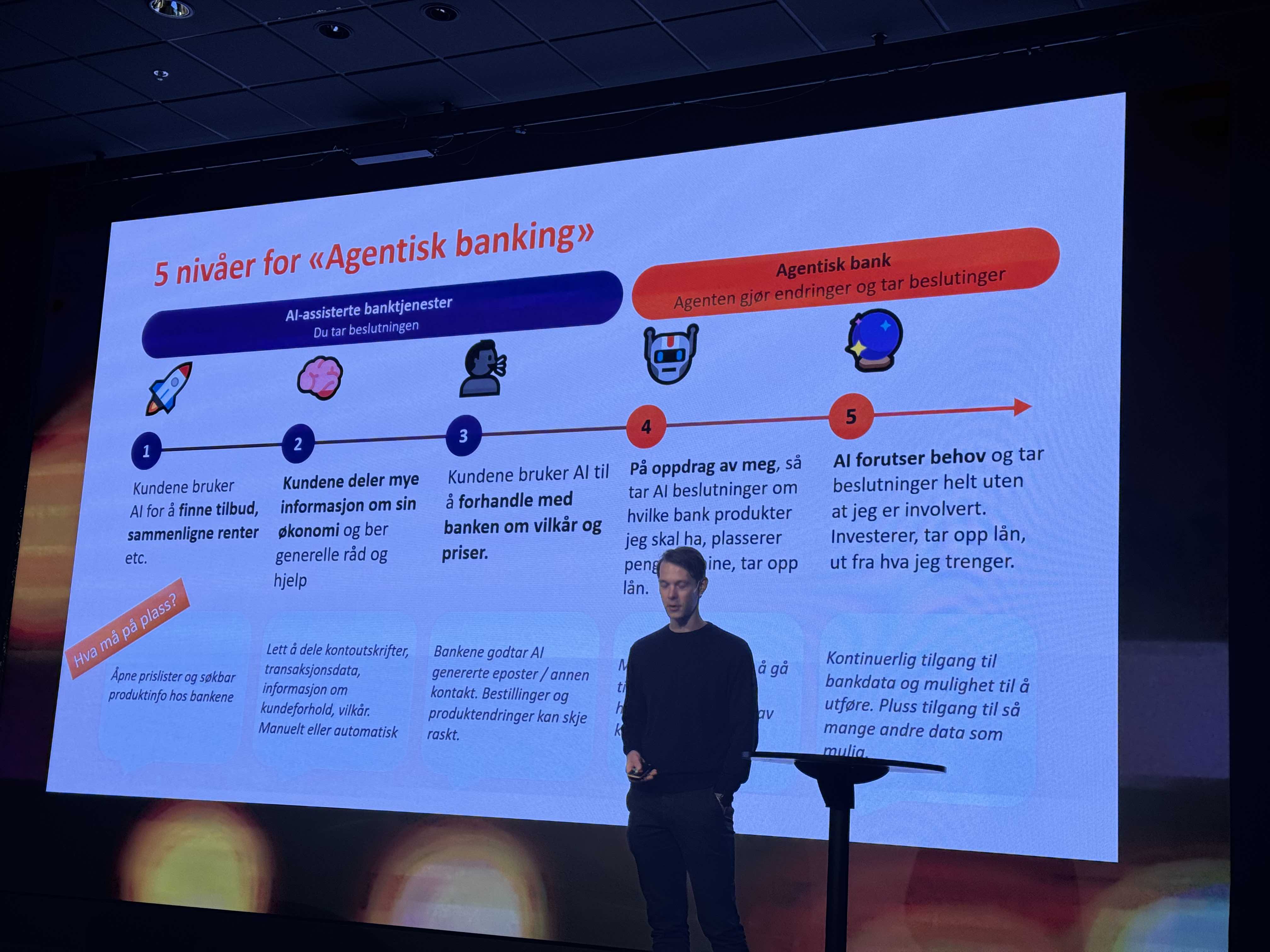
Photo: Vegar Wikhammer Heir at Finans Norge's payments and digitalisation conference.
Agentic commerce and agentic banking are about artificial intelligence increasingly acting and making decisions on people's behalf – from comparing prices to, eventually, completing purchases and moving money itself. Vegar Wikhammer Heir, Chief Commercial Officer at Vipps MobilePay, spoke about the development at Finans Norge's payments and digitalisation conference, focusing on how well positioned Norwegian and Nordic banks are for it.
Heir points to statistics from ChatGPT's launch in various countries, where the Nordics had the highest share of the population who had tried the service. The Nordics also have a lot of shared digital infrastructure – such as a fully digitalised shipping industry – and high trust in digital services, with BankID as an example. Most people already shop from smartphones and online, which means AI commerce, and eventually AI banking, can be adopted by a large share of the population.
Heir outlined five levels of what he calls agentic banking. At the first level, customers already use AI to compare rates, loans and credit card perks. At level two, they share information, for example by uploading a bank statement to an AI agent for general advice – but the customer still has to switch banks themselves. At level three, the AI agent can negotiate directly, for example by sending requests to several banks about loan rates at once, still with the customer in control.
At level four, AI makes decisions about banking products on the customer's behalf, and must then be able to log into the bank and act there – something Heir says banks today are still some way from opening up for, even though it is technically possible. At the fifth and most speculative level, the customer shares extensive information about their life – such as a cabin, family and car – so that the AI continuously adjusts their finances, plans holidays and makes financial decisions without asking first.
Internationally, things are moving fast. ChatGPT has built a connection giving American banks account-to-account access, and the day before Heir gave his talk, Claude launched a "Personal Finance Manager" linked to users' bank accounts. Meta's AI assistant Muse already acts as a financial adviser, but has been shut out by JPMorgan, among others. On the business banking side, some banks have already opened up for AI agents to retrieve data and carry out actions on behalf of business customers.
Heir believes the Nordics are technically better positioned for AI banking than anywhere else in the world, even though the development is moving fastest in the US right now. He points to three possible winners: established banks building AI capabilities, the big AI companies that could themselves become the customer's banking interface, and new banks with no legacy technology to work around, such as Revolut.
During the Q&A, it emerged that half of users are already active on Revolut, while the rest mainly use the app when travelling abroad – and that Revolut plans to open a branch in Norway.
Sources: Vipps MobilePay
You have read what you can read for free. With an account you get unlimited access to all news and articles on kaupr.io — and become part of the network of investors, professionals and builders following onchain finance.