

Three teams reached the Blockathon Stockholm final with answers to problems set by AIMS-Management, the Swedish Red Cross and UNICEF. All use blockchain to verify that a creator approved content, that a message is genuine and that aid was delivered.
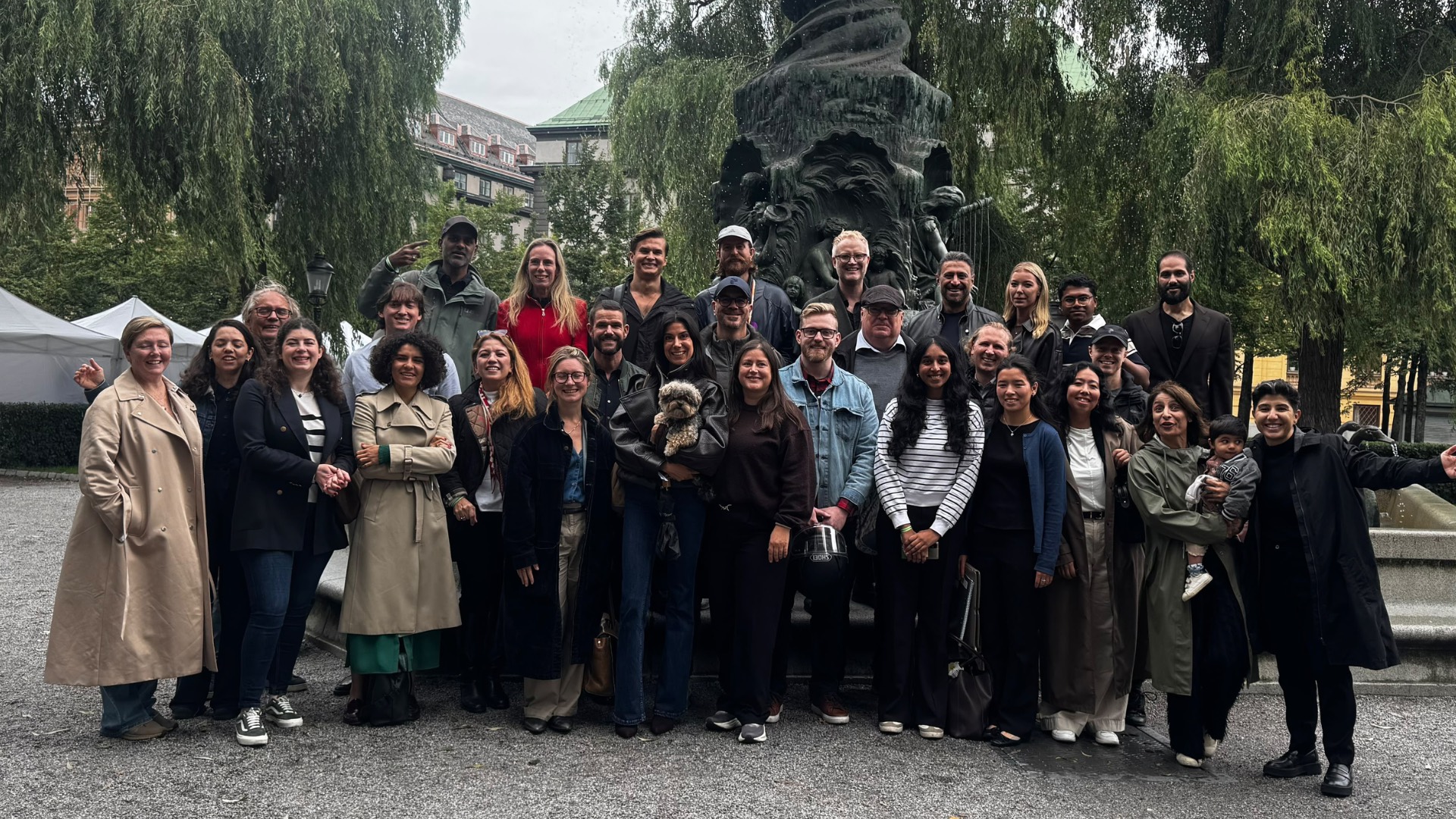
Finalists, jury members, mentors and organisers gathered after Demo Day in Stockholm.
The finalists in Blockathon Stockholm presented their solutions at Demo Day in Kungsträdgården on Thursday. Each team responded to one of three problem statements that Kaupr has presented in Onchain Build.
The team behind OWND responded to the problem statement from Madina Saleh of AIMS-Management on creators whose faces are recreated without anyone asking, and started from the creator's own position. The team described how someone can post a video of her saying something she never said, and get both her followers and brands to believe it. Today, nobody can prove it was not her, the team argued.
The solution turned the problem around. Rather than trying to detect content made with artificial intelligence, OWND documented what the creator had actually approved. Each file received a digital fingerprint to which her consent was tied, and if the file was altered, it no longer matched what she had agreed to. No personal data was put on the blockchain.
"Blockchain does not make a false claim true. It makes a true claim impossible to erase," the team's presentation said. The team gave the solution the tagline "Proof that it is you".
The team pointed out that the EU AI Act has required labelling of AI-generated content since 2 August, and described OWND as the other half: whether the person actually agreed.
FirstMark responded to the problem statement from Melanie Rideout of the Swedish Red Cross on three directions for technology in humanitarian work, and built on two of them: crisis communication and verifiable information. The team framed the problem as misinformation and AI-generated content making it harder to know whether a message really comes from the Swedish Red Cross.
The solution was named FirstMark, with the subtitle "Verifiable crisis messages". The sender signed the message digitally and set how long it would remain valid. The recipient could see that the content was verified and open a receipt showing who sent the message, when it was published, when it expired and a digital fingerprint of the content. The idea was for the fingerprint to be registered on the blockchain and the message itself to be stored elsewhere.
The team itself noted that trust also depends on knowing whose signing key it is.
U-proof responded to the problem statement from Arun Maharajan of UNICEF on proof from the field. The team consisted of Ashita C. Kolla, Catalina Pizarro, Eylül Balcilar and Hadisa Anwari. They framed UNICEF's problem as capturing credible proof that programmes work, directly from the field. The proof was to be submitted by citizens themselves, captured on site, and be verifiable and trackable.
The team showed a mobile web app in which the user took a photo with the in-app camera, with location and time attached automatically. UNICEF reviewed the submission before approving it. Where Arun Maharajan had used toilets, solar panels and vaccinations as examples, the team demonstrated the solution on a nutrition programme in which recipients photographed their meals.
The photo was stored in UNICEF's own database, while a fingerprint of the photo, together with area and time, was registered on the Base blockchain. The tagline was "Aid that's verified, every proof".
Sources: FirstBlock-athon, OWND, FirstMark, U-proof, Kaupr
You have read what you can read for free. With an account you get unlimited access to all news and articles on kaupr.io — and become part of the network of investors, professionals and builders following onchain finance.

