

DNB's SVP Ole Morten Sunde says no to whether stablecoins will go mainstream, not because the technology falls short, but because everything around it keeps moving. Domestic payment use in Norway is close to zero, and in Europe the problem stablecoins actually solve keeps shrinking.
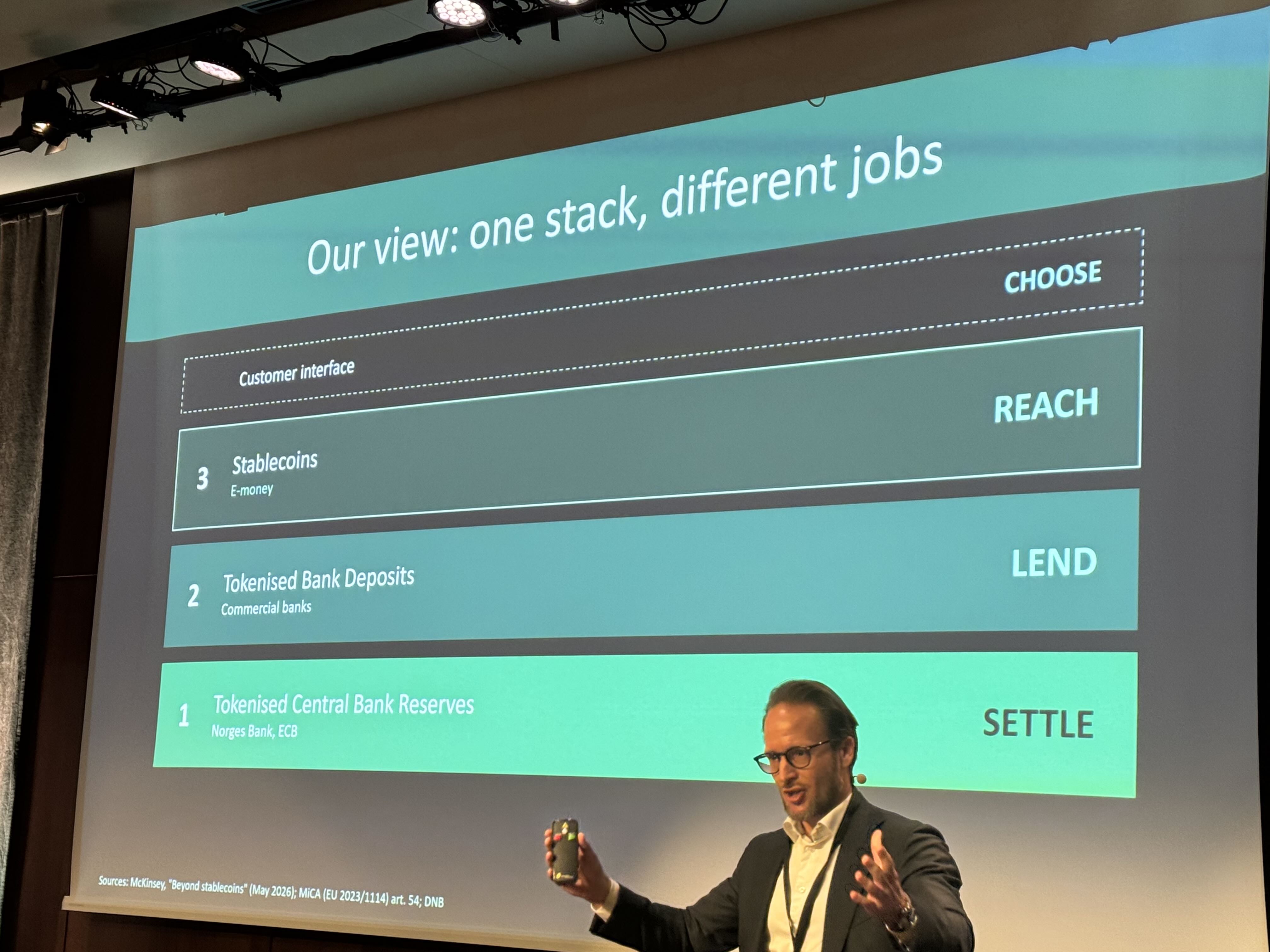
Photo: SVP Ole Morten Sunde of DNB spoke about stablecoins and tokenised deposits at the Visa Stablecoin Summit in Oslo.
The question Ole Morten Sunde, SVP and Head of Emerging Business – Products at DNB, got at the Visa Stablecoin Summit in Oslo was simple: will stablecoins go mainstream? For Sunde, the word means something concrete: people getting paid their salary in stablecoins, paying taxes with them, and them being accepted everywhere. His answer was no, not because the technology falls short, but because everything around it keeps moving.
Domestic stablecoin use for payments in Norway is close to zero, Sunde said. And in Europe, he argued, the very problem stablecoins are meant to solve keeps shrinking by the month. Instant payments are becoming the norm, and banks must now offer cost-free instant payments across Europe. Vipps and ordinary bank transfers are already near-instant in Norway, and Vipps has expanded its reach across Europe, alongside comparable solutions such as Bizum, MB WAY and WERO elsewhere on the continent.
At the same time, tokenised deposits are moving up as an alternative. Where a traditional bank deposit meets only two of five properties in a framework Visa has presented – global, programmable, available 24/7, within banking regulation, and backed by deposit insurance – Sunde argues a tokenised deposit meets all five.
Central bank money is moving onto the chain too. Norges Bank runs a shared ledger with 12 participants, with DNB among them.
The stablecoin market has grown to roughly $300 billion in total value, but has flattened somewhat in 2026, and payment usage is growing more slowly than the year before. Sunde pointed to three conditions that need to be in place before stablecoins can go mainstream.
The first was broader adoption: more banks and companies need to start using stablecoins for payments, not just crypto trading. The second was that the market needs currencies other than the dollar on-chain. The dollar dominates completely, partly because the US has pushed for it, and partly because it simply is the dollar. Euro stablecoins account for only around $1 billion of the roughly $3 billion in circulation in euro-denominated stablecoins, while the euro makes up about 25 percent of the money supply in the traditional system.
The third condition was regulation that is better harmonised across borders and more favourable to market participants. A concrete example is the US debate over whether issuers should be allowed to pay interest on stablecoins, a question Sunde said was pushed further down the road in the Clarity Act in September, partly because the banking lobby fears interest on stablecoins would pull deposits out of the banking system.
Sunde laid out use cases on a scale from the left, where stablecoins are a solution looking for a problem, to the right, where they actually address a problem DNB itself recognises. Ordinary in-store payments and cross-border card payments already work well, so stablecoins solve little there. Payments between AI agents are interesting but still marginal, and stablecoin-linked payment cards show somewhat more traction.
Further along the scale, where stablecoins do address a real problem, Sunde pointed to reach: getting money into corridors where banking systems are weak, companies paying each other across borders, and companies wanting to hold dollars in their own cash balances.
The same picture emerged in a fresh survey from Norges Bank: only 19 percent of Norwegians have heard of stablecoins. Of those, 28 percent have actually bought one, and of the buyers, only 12 percent have used it to pay for something – the rest have traded crypto.
Sunde illustrated the reach point with what Visa has called a "stablecoin sandwich": a Norwegian shipping company sending money to the Philippines. The traditional route runs through correspondent banks, each of which has to run checks against sanctions, money laundering and fraud, on top of being hit by cut-off times, weekends and time zones. The transfer can take days, in the worst case weeks. The stablecoin route is fast in the middle – the transaction itself takes seconds – but the "bread" of the sandwich is still there: the kroner have to be converted into a dollar token because that's where the liquidity is, and the token then has to be converted into Philippine pesos locally, with the same checks as in the traditional system. That matched findings from a study Banca d'Italia carried out this summer, in which the bank sent money from Italy to ten different corridors and found no systematic cost advantage, even though the blockchain leg itself was cheap.
Asked whether he himself expected to get his salary on-chain, Sunde said yes, but in the form of a tokenised deposit from his own bank, not a stablecoin.
DNB's own model splits digital money into three layers with different jobs. At the bottom sit tokenised central bank reserves, run by central banks such as Norges Bank and the ECB, whose job is to settle between banks. In the middle sit tokenised deposits from commercial banks, whose job is to lend money and create credit. At the top sit stablecoins, a form of e-money, whose job is to provide reach.
Bank deposits, Sunde said, do what they've always done best: they can be lent out to create credit growth, they pay interest, and they carry deposit insurance. Stablecoins, for their part, are best at reach: anyone with a wallet can send to anyone else in the world, around the clock, even into places the banking system itself has pulled out of.
His conclusion was that all forms of money will coexist, each with its own use cases. The competition, Sunde said, will play out within each layer, not between them: wallet versus wallet, bank versus bank, issuer versus issuer.
Sources: Visa Stablecoin Summit, Oslo; Norges Bank
You have read what you can read for free. With an account you get unlimited access to all news and articles on kaupr.io — and become part of the network of investors, professionals and builders following onchain finance.