
Awareness of stablecoins among Norwegians has nearly doubled since 2024, special adviser Suela Kristiansen of Norges Bank showed at the Visa Stablecoin Summit. Yet 72 percent have never bought one, and men know them four times better than women.
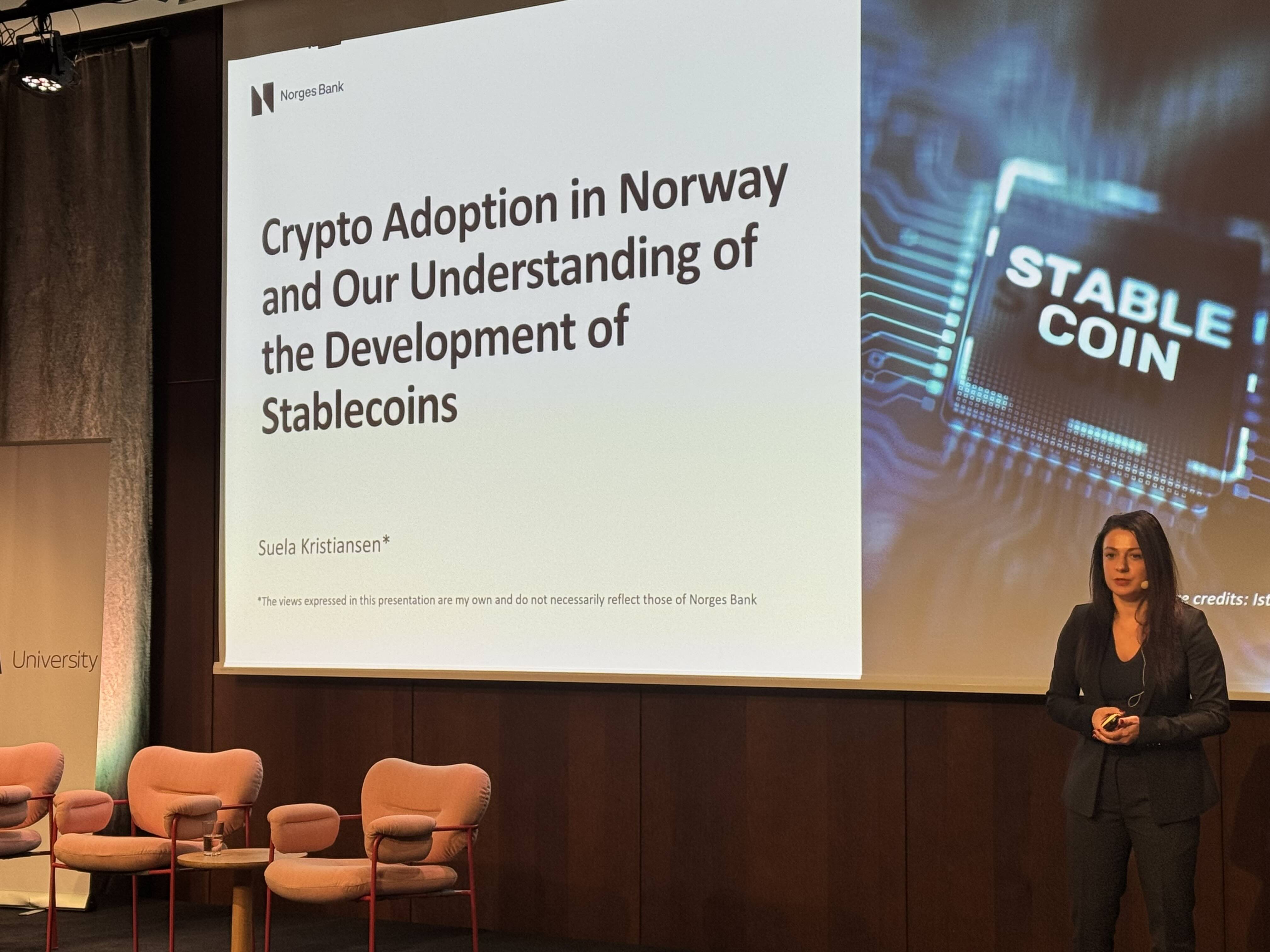
Photo: Suela Kristiansen, special adviser at Norges Bank, spoke about stablecoin awareness at the Visa Stablecoin Summit in Oslo.
Suela Kristiansen is a special adviser at Norges Bank and is behind the central bank's survey on crypto assets in Norway, a representative survey she herself initiated in 2022 and which is now carried out every other year. At the Visa Stablecoin Summit in Oslo, she presented fresh figures on how well Norwegians actually know stablecoins – currency-stabilised crypto assets mostly tied to the dollar – and how that awareness actually translates into use.
According to the survey, 19 percent of the Norwegian population has now heard of stablecoins, up from 10 percent in 2024. By comparison, 97 percent have heard of crypto assets in general, while only 12 percent own any today.
"The good news for all stablecoin enthusiasts is that we've almost doubled awareness among the population," Kristiansen said. The bad news, in her view, is that this awareness hasn't necessarily translated into purchases and use.
Among those who know about stablecoins, 72 percent say they've never bought one, up from 56 percent in 2024. The increase is tied to the awareness group itself having grown sharply over the same period, according to Kristiansen.
The figures also show a marked gender gap: men are roughly four times as likely as women to have heard of stablecoins. Kristiansen flagged this as a separate finding worth noting, alongside men generally having higher awareness of individual crypto assets than women.
Among those who have actually bought stablecoins, Tether (USDT) and USD Coin (USDC) are clearly the most used, followed by DAI/USDS. That matches what's otherwise seen in the market for these assets, according to Kristiansen.
The main reason for buying stablecoins is still trading other cryptocurrency – moving in and out of other crypto assets. Storing value is the second most common reason, while the third is learning about and testing the technology itself – a good share of the group, in Kristiansen's assessment, uses stablecoins precisely to explore how they work.
Kristiansen also spent time nuancing a common claim about stablecoins: that they're transparent because transactions sit openly on-chain.
"It's easy to say stablecoins are good or bad, and that's not a very interesting discussion for me. I'd rather focus on the nuances," she said.
According to her, the transparency claim itself is often misunderstood: even though transactions are visible on a blockchain, you usually don't know who is actually behind a given address. That gives users a degree of pseudonymity, but not full clarity on who the end users of stablecoins are – something she argues is relevant both regulatorily and for players like Tether, which has previously drawn considerable media attention for a lack of transparency about its reserves.
Kristiansen also pointed to a concrete gap in what she and her colleagues at Norges Bank know: how institutional players in Norway actually use stablecoins. While the survey gives a good picture of individuals' awareness and use, far less information is available on which use cases are gaining traction among Norwegian institutional players.
She therefore encouraged conference attendees to share their own experiences and use cases from a Norwegian perspective, as input for the continued work of understanding adoption.
Sources: Visa Stablecoin Summit, Oslo; Norges Bank Memo 6/2026: “Undersøkelse om kryptoeiendeler i Norge”
You have read what you can read for free. With an account you get unlimited access to all news and articles on kaupr.io — and become part of the network of investors, professionals and builders following onchain finance.