
From 2027, Norwegian banks must support the digital EU wallet, says Norway's Digitalisation Agency (Digdir). The groundwork has been sent to the ministry, and the solution is piloted with Mastercard and Amadeus.
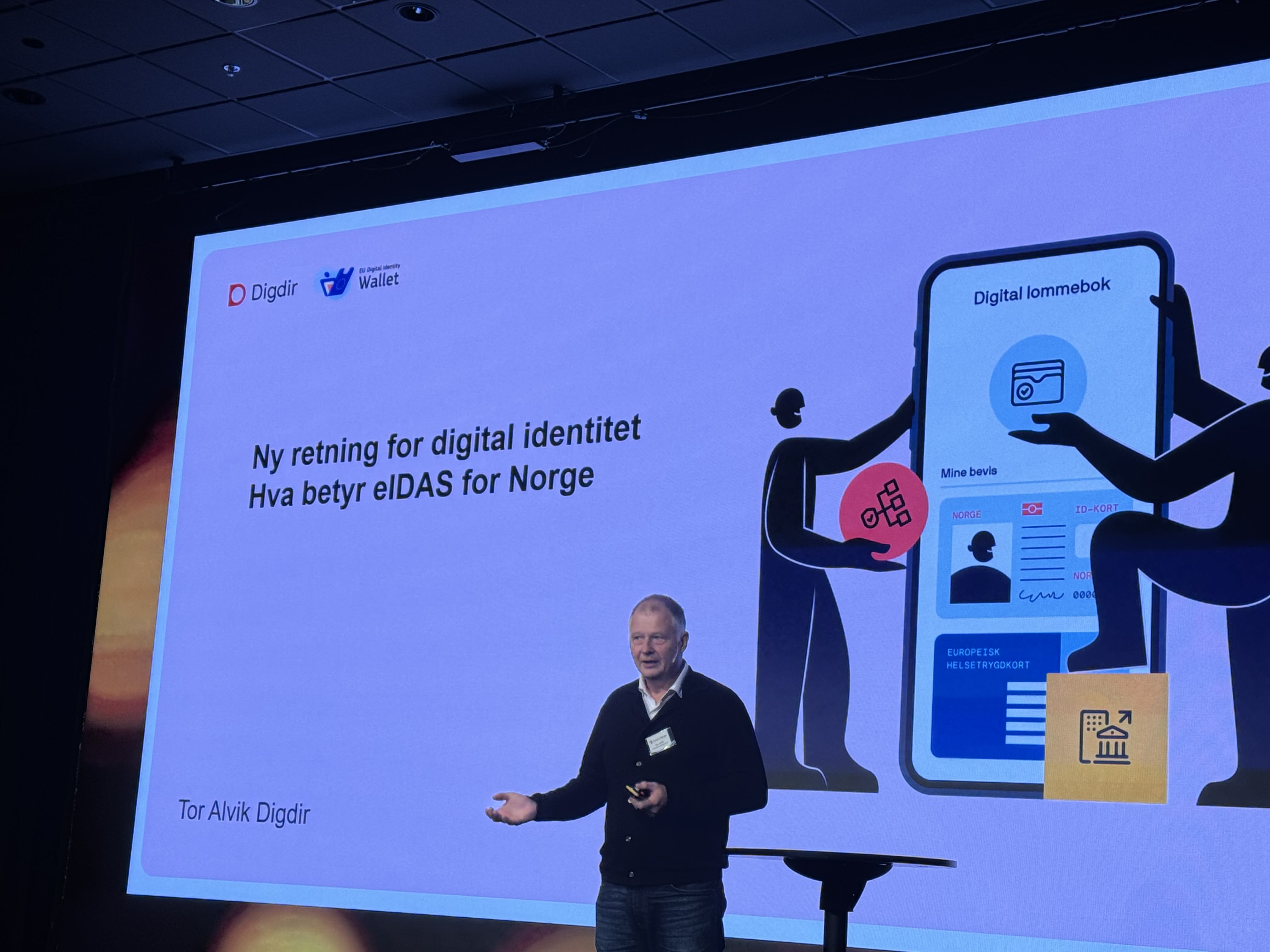
Photo: Tor Alvik at Finans Norge's payments and digitalisation conference.
The EU's eIDAS 2.0 regulation introduces digital ID wallets meant to give citizens an identity that works across EU/EEA borders, and which, besides confirming who you are, can also prove what you're entitled to do — such as a driving licence, age or professional qualifications. Because the regulation is EU law via the EEA agreement, it becomes Norwegian law word for word once implemented. Tor Alvik, department director at Norway's Digitalisation Agency (Digdir), presented the status of Norway's work at Finans Norge's payments and digitalisation conference.
The regulation introduces a duty for anyone offering strong customer authentication — such as online banking logins — to support the digital EU wallet for those services. In the EU, the deadline is 2027. In Norway, the deadline will follow Norwegian legislation, but Alvik says banks should expect European customers who want to use the wallet in Norwegian online banks too.
The services will come in addition to ordinary login solutions. Alvik pointed out that players like Stø could take on a role as an intermediary layer between the wallet and the financial industry — a separate part of the regulation describes a similar intermediary layer for the public sector.
Digdir has completed a concept assessment addressing how the regulation should be implemented in Norway, which now awaits a government decision. At the same time, the agency has prepared the legislative process itself and sent the groundwork to the ministry so the ordinary legislative process in Norway can begin.
Digdir has also built a pilot — called a "sandbox" — where industry players can test how the digital wallet works in practice. Alvik says Digdir has worked with Mastercard and Amadeus, among others, on large-scale pilots covering the entire travel chain — from ticket purchase to flights, car rental and hotels — to test proof-of-payment in the wallet.
Several European countries are further ahead than Norway. Germany has run a pilot project worth around NOK 1.9 billion and is launching its first wallet in January, a solution Romania has also adopted as open source. Denmark launched its solution in summer 2026, Finland has concrete plans and is underway, while Sweden — like Norway — is taking more time. France, Spain and Italy are also investing heavily.
Alvik says the regulation is meant to make the wallets consistent across countries, and notes that the law requires states to offer the wallet free of charge to citizens and to cover the costs of enrolment and ID verification. Free validation mechanisms must also exist for banks and others to confirm users' identity, along with free signing for private use.
Sources: Digdir (Norwegian Digitalisation Agency)
You have read what you can read for free. With an account you get unlimited access to all news and articles on kaupr.io — and become part of the network of investors, professionals and builders following onchain finance.