

A master's thesis by two KTH students examines why crypto exchanges and brokers are shifting from retail crypto trading toward selling services to banks and institutions. MiCA provides legitimacy, but trust and knowledge gaps still slow adoption.
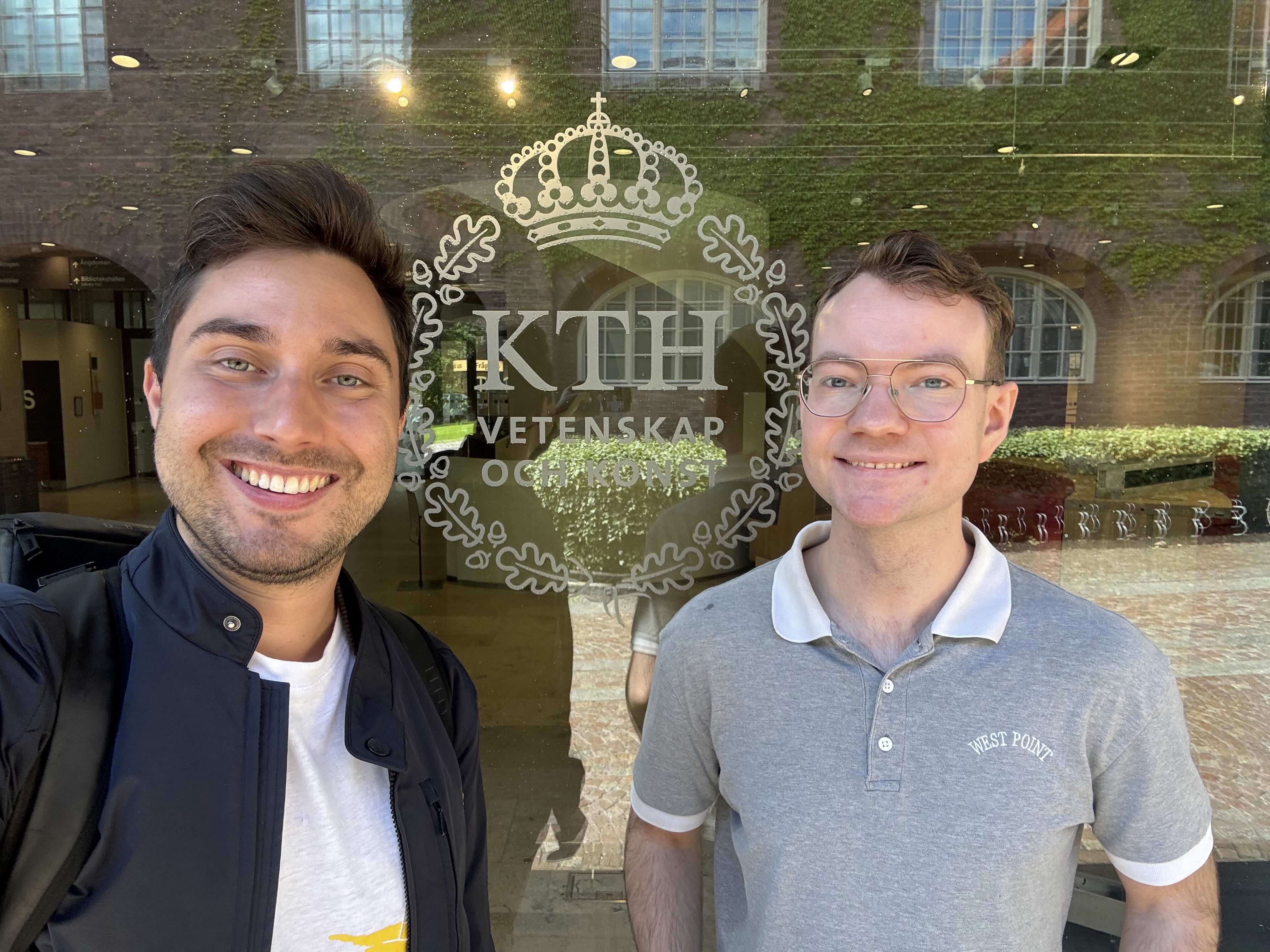
Nando Alexander Schmidt (left in the photo) and Adam Michael, two students at KTH in Stockholm, examine why crypto exchanges and brokers are moving away from pure retail trading to offer services directly to banks and other institutions — a model they call Crypto-as-a-Service (CaaS). The Swedish crypto exchange Safello served as the case company for the thesis, which draws on twelve interviews with employees at crypto exchanges, banks and family offices. The thesis, "From Retail Brokerage to Institutional Business-to-Business Enablement: Transition Drivers and Adoption Requirements for Crypto-as-a-Service", is also available in full.
The thesis distinguishes between two main models for how crypto exchanges and brokers can deliver services to banks and institutions. In the first, B2B2C, the services are embedded within a bank or other institution, which then offers crypto onward to its own end customers. In the second, the institution itself becomes the end user of the service — this applies to family offices, hedge funds and pension funds in particular, which want direct control over their own custody, trading and allocation rather than going through a traditional broker.
The authors point out that these two buyer groups have partly different needs and decision-making processes, meaning crypto exchanges and brokers must adapt both their service offering and sales approach depending on who the actual customer is.
According to the thesis, part of the explanation for the shift lies in the business model of crypto exchanges and brokers themselves. Revenue in retail brokerage is largely transaction-based and therefore fluctuates with both trading volume and crypto market cycles, while costs such as legal work and compliance remain fixed. That makes profitability vulnerable when the market is weak.
Services aimed at banks and institutions instead offer more predictable revenue, through fixed fees and long-term agreements. The authors note that many crypto exchanges and brokers have, over time, built up expertise in compliance, custody of digital assets and transaction monitoring as a consequence of tighter regulation — expertise that can now be reused and sold on to actors that lack it themselves.
The EU's crypto regulation MiCA is highlighted as the single most important factor behind the shift. The framework has given the industry clearer rules and helped normalize crypto firms in the eyes of banks, according to the interviewees in the study.
At the same time, the thesis points out that MiCA does not remove the risk for banks and institutions that choose to buy such services. Under EU law, responsibility for customer due diligence and anti-money laundering (KYC/AML) cannot be outsourced — the buyer retains regulatory responsibility regardless of how much of the operational work is handed to an external provider. That means the buyer itself needs sufficient internal expertise to oversee and control the provider, which in practice limits how much it is willing to outsource.
A consistent finding is that banks lack both the technical infrastructure and the specialists to handle digital assets themselves. According to the study, it is unlikely that banks will build their own custody technology for crypto assets from scratch, since specialized providers have already spent years developing exactly that. Partnerships therefore appear to be a more realistic path into the market than building in-house.
Exchange-traded products tracking crypto values (ETPs) are highlighted as an easier entry point for banks, since they can be offered through existing and familiar structures. But according to the thesis, such products can only cover part of the need — they do not provide access to the underlying infrastructure required for more direct use cases, such as decentralized finance.
When banks and family offices assess potential CaaS partners, reputational risk and trust weigh more heavily than price, according to the study. This is especially true in a small, tight-knit market like Sweden's, where actors know each other and negative media coverage can carry significant consequences. According to the authors, none of the banks or institutions in the study are yet fully ready to enter direct agreements for crypto services — most are waiting and observing, for others to move first.
This caution is also confirmed by co-author Nando Alexander Schmidt, who experienced first-hand how sensitive the topic is while trying to find interview subjects for the thesis:
"As soon as they heard the word crypto, they got scared and backed off."— Nando Alexander Schmidt, co-author of the thesis
Local presence stands out as a clear competitive advantage in the Nordic market. The study shows that both banks and family offices prefer partners with an established track record and geographic and cultural proximity over global players without local roots. At the same time, the authors point out that aggressive sales approaches are counterproductive — banks and institutions prefer to initiate contact themselves, after conducting their own research, rather than being approached directly.
The thesis concludes that Crypto-as-a-Service can be understood neither as a purely technological story nor a purely regulatory one. Regulation has made the path into the market possible, but it is trust, local knowledge and patience that ultimately determine how quickly banks and institutions actually put it to use.
Sources: Michael, A. and Schmidt, N.A. (2026), "From Retail Brokerage to Institutional Business-to-Business Enablement: Transition Drivers and Adoption Requirements for Crypto-as-a-Service", KTH Royal Institute of Technology; interview with Nando Alexander Schmidt (Kaupr)
You have read what you can read for free. With an account you get unlimited access to all news and articles on kaupr.io — and become part of the network of investors, professionals and builders following onchain finance.
