

AI agents could handle about a third of global e-commerce purchases by 2030, a new Mastercard report finds. Teenagers are far more open to it than parents, but banks must first solve identity, consent and liability when an AI agent shops on its own.
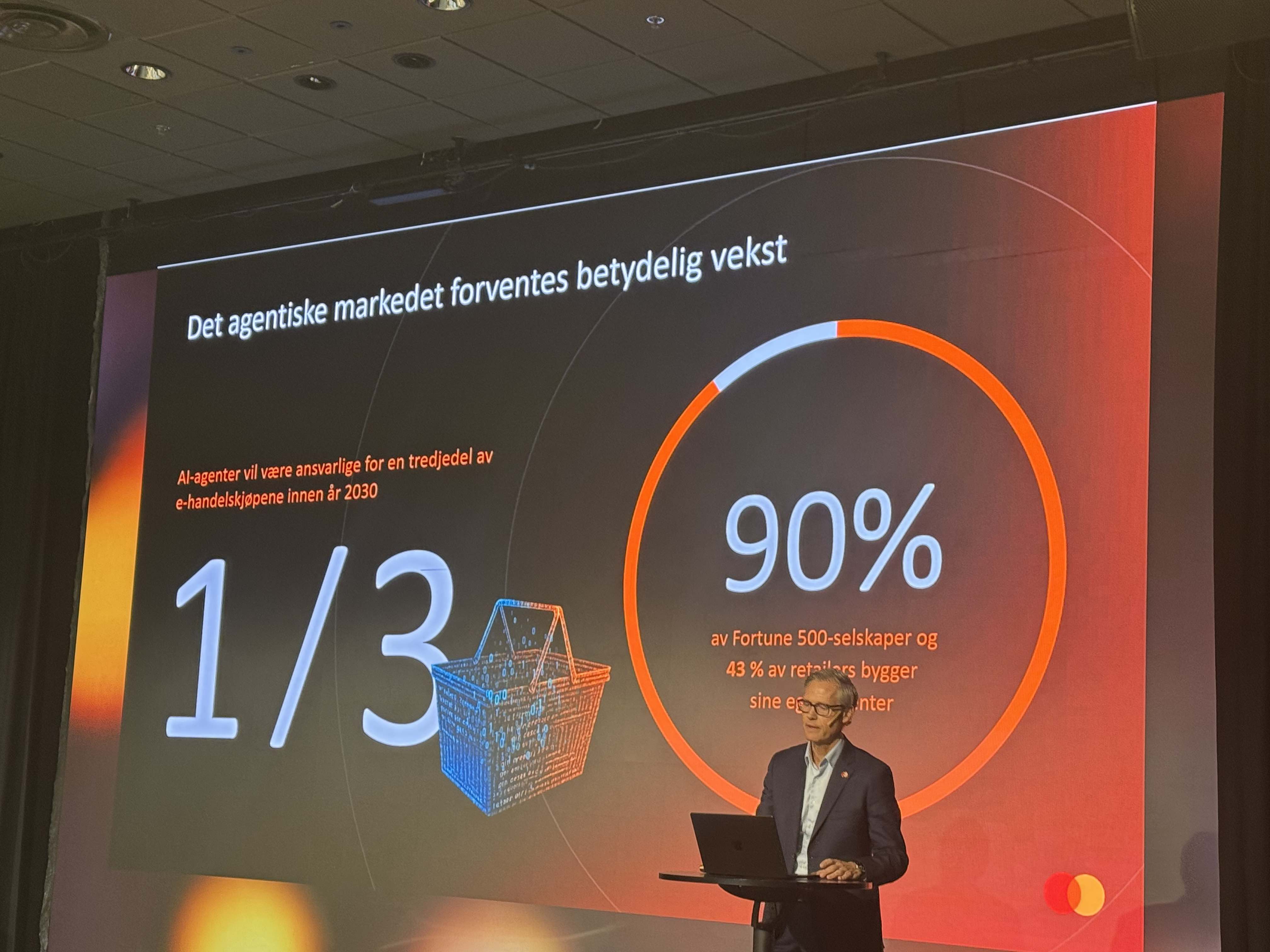
Photo: Inge Kjønnøy from Mastercard at the Payments and Digitalization Conference
Agentic commerce describes an AI agent shopping on a consumer's behalf — searching for products, comparing price and terms, and completing the purchase, with varying degrees of human approval along the way. The findings come from a Mastercard report that Inge Kjønnøy, Country Manager Norway at Mastercard, presented at Finans Norge's payments and digitalization conference. The report draws on both a global analysis of e-commerce and a survey of 26,000 parents and teenagers, including in Norway and Sweden.
In the survey, teenagers are roughly twice as likely as parents to embrace agentic shopping: 27 percent of teenagers are likely to use a fully AI-driven assistant, against 16 percent of parents. Trust is shifting too: 31 percent of teenagers trust AI more than a friend's recommendation, and 23 percent trust an AI agent more than their parents' advice. 62 percent of teenagers expect AI to change how they shop.
Parents themselves are aware of the gap: 69 percent believe their children's generation will be more comfortable with AI than they are, but only 4 percent think their own generation is already comfortable shopping through an agent. In practice, many are already doing so: 42 percent of teenagers and 35 percent of parents have used AI to complete a purchase at least once. Among parents there is also an age gap — those aged 18 to 34 are nearly twice as likely as those over 55 to adopt a dedicated AI shopping assistant.
Adoption will also vary between markets, because it follows existing trust in e-commerce. In the UK, 28 percent of retail already happens online, against just 14 percent in France — a gap the report ties to differing levels of trust in e-commerce between the two countries.
Kjønnøy pointed out that routine purchases will be the first to shift to agents: groceries, refills and subscriptions. They are low risk, repetitive and easy to deliver. The report also expects e-commerce's share of retail to stabilize at around a third across most of Europe, because shopping is also leisure — the more virtual our lives become, the greater the value of shopping in person. Control will set the pace: Mastercard's digital lead advises consumers to set spending limits, define preferences and approved stores, and decide when the agent must come back for approval.
For stores, it comes down to being readable to agents. An agent doesn't trust marketing copy or time-limited offers — it checks price, availability, delivery terms and certifications directly. – If your information as a store isn't machine-readable, you're invisible, said Kjønnøy, citing Shah, one of the report's authors. An agent looking for organic cotton or carbon-neutral delivery goes straight for the certificate — and agents negotiate and shop whenever it suits them, including at three in the morning.
For banks and payment providers, trust stops being a brand feeling and becomes infrastructure. Every agent transaction has two streams: money, and proof of identity, authorization and intent. Kjønnøy pointed to three key areas for banks: consent and limits, where authority must be clear and revocable; identity for agents — a new term, "know your agent," expected to become as central as today's customer checks; and the question of who pays when something goes wrong. Banks themselves prefer that the bank and payment provider carry out these checks, since consumers already trust them.
The report recommends registering agents before trusting them: knowing who you're dealing with, verifying that the agent is legitimate, who it represents, and that it has authority to carry out the specific action. The report expects at least three G20 countries to issue formal guidance on agent registration by 2030, and that early movers on this will gain a compliance advantage. Authorization must also move down to the transaction level — not a box ticked to accept everything from an agent, but limits set per transaction, with tokenized credentials that are meaningless if leaked and can be cancelled without cancelling the card itself.
For consumers, it comes down to visible limits, a simple undo button, and a place to see and switch off the agent's authorizations. For stores, it means making information machine-readable — starting with one product category: price, availability, delivery terms, loyalty benefits and key requirements agents can read and verify, and treating the agent like a known customer, not a stranger. For banks, it means knowing the agent, approving each transaction and having a plan for other purchases. Kjønnøy said this has already been tested live with several banks in Norway.
Sources: Mastercard
You have read what you can read for free. With an account you get unlimited access to all news and articles on kaupr.io — and become part of the network of investors, professionals and builders following onchain finance.