The tokenized ETF market has passed $500 million, driven by Ondo Finance. BlackRock CEO Larry Fink says tokenization will be the next generation for securities, while regulation continues to slow down the industry.
The market for tokenized ETFs recently passed $500 million in value, with Ondo Finance as the clear leader. At the same time, big names in traditional finance have begun referring to tokenization as the next step for securities markets, rather than just a crypto experiment. For an investor or manager in the Nordic region, this is relevant because it points toward a gradual shift in how ownership of shares and fund units is registered and transferred — a development that could eventually impact settlement, costs, and cross-border access.
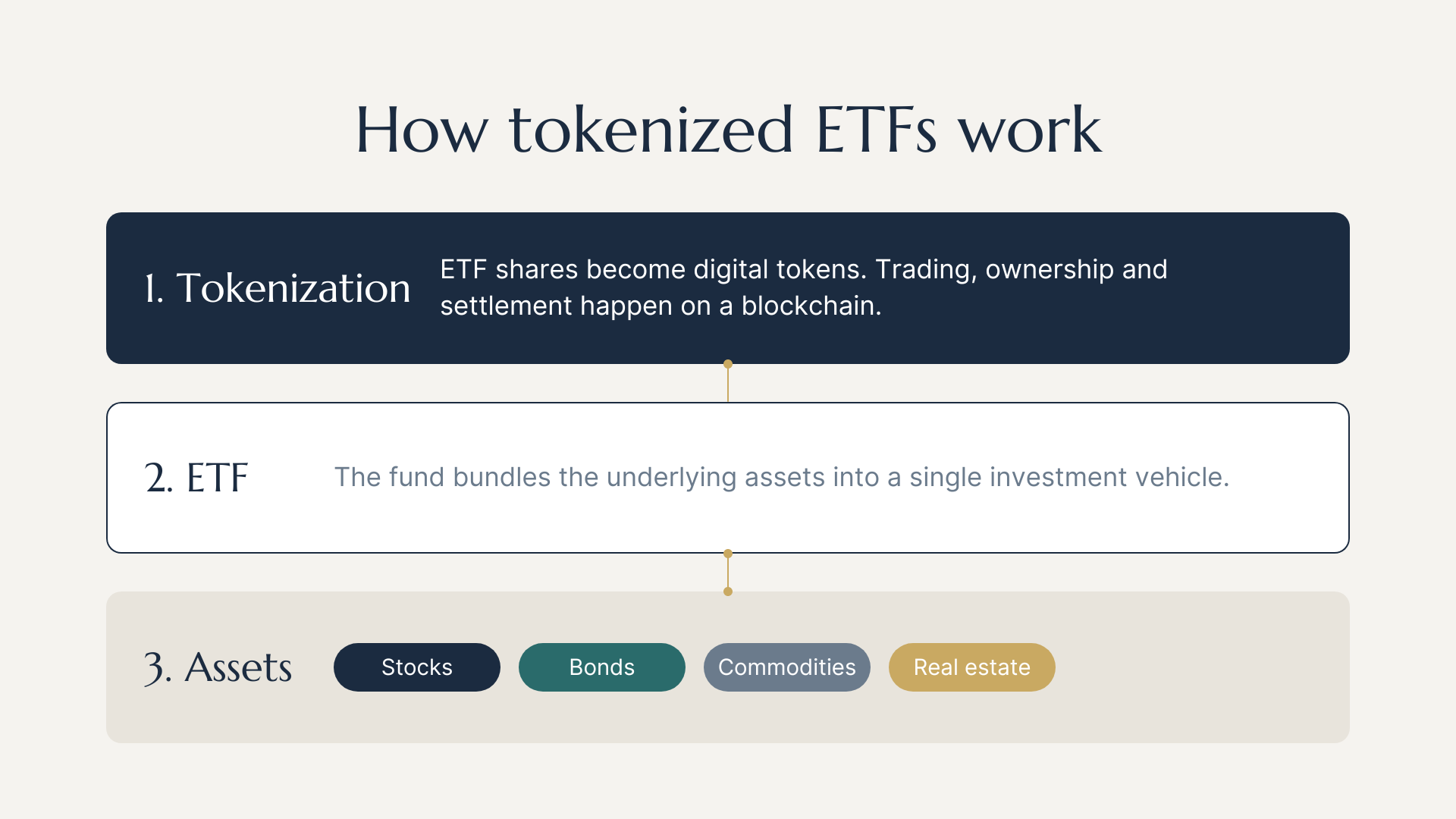
A tokenized ETF is a digital representation of a share in an exchange-traded fund. The investor owns a token in a blockchain wallet, while a regulated entity holds the actual fund share with a custodian. This provides two layers of exposure: the token tracks the value of the fund share, and the fund share, in turn, tracks the value of a basket of underlying securities — stocks, bonds, or commodities.
The price is kept in check through two mechanisms operating simultaneously. At the fund level, traditional market participants ensure that the fund share stays close to its so-called NAV (the fund's actual underlying value) through the ongoing issuance and redemption of shares. At the token level, investors can exploit price discrepancies between the token and the fund share for arbitrage, which in practice pulls the token price back toward the fund value. Issuers of such tokenized funds include Ondo, Backed Finance, and Dinari.
The interest is about more than just technology. BlackRock CEO Larry Fink has stated that the next generation for securities markets will be tokenized, comparing the shift to the transition from post mail to email — securities should be able to move directly, without intermediaries having to confirm every step along the way.
These statements are backed by concrete actions. In March 2026, the US Securities and Exchange Commission (SEC) approved a move allowing Nasdaq to let tokenized versions of Russell 1000 stocks and index funds trade in the same order book as traditional securities. BlackRock's own tokenized fund, BUIDL, currently manages around $2,8 billion across six different blockchains, and the company applied in May 2026 to launch additional tokenized funds.
Ondo Global Markets, which launched in September 2025 with around 100 tokenized assets on Ethereum, has grown in ten months to over 440 tokenized US stocks and ETFs, spread across Ethereum, Solana, and BNB Chain. Total trading volume has passed $9 billion, with tens of thousands of users globally — mostly outside the US.
Recent progress can largely be attributed to IVVon, Ondo's tokenized version of one of the world's largest ETFs, which rose around 150 percent in May 2026 alone, helping the entire tokenized ETF category grow from about $430 million to over $500 million. In June 2026, Ondo also introduced 24/7 continuous issuance and redemption, and the company filed a registration application with the SEC in February of the same year.
Because a tokenized ETF has two layers between the investor and the underlying assets — the token and the fund share itself — what is known as tracking error can occur, meaning the token price diverges from the fund's actual value. Thin liquidity in blockchain trading and delays in arbitrage are typical causes. Additionally, the extra custodian layer lengthens the chain of institutions that the exposure depends on, compared to a tokenized single stock.
Ondo's market share, estimated between 66 and 74 percent depending on the analysis, makes the company dominant — but also a single point of failure for the entire segment if operational issues or regulatory actions targeting Ondo were to arise.
A recent survey by the analytics firm Acuiti among executives in the ETF industry shows that nearly half expect tokenized ETFs to make up a significant part of the market within three to five years. At the same time, respondents pointed unequivocally to regulatory uncertainty, rather than technology, as the biggest hurdle to moving from pilot projects to commercial products.
The survey also indicates that traditional custodians are the type of financial actor the industry believes will be most challenged by this development, as tokenization can automate parts of the settlement and ownership registration that are currently handled manually.
Sources: Crypto Briefing, Stobox, Asortino, FinanceFee
You have read what you can read for free. With an account you get unlimited access to all news and articles on kaupr.io — and become part of the network of investors, professionals and builders following onchain finance.