
On Friday, Goobit founder Christian Ander appeared live on Kaupr TV to elaborate on a new M&A strategy for the Nordic crypto market, which Goobit and BTCX had made public only minutes earlier. Here you can watch and read the interview
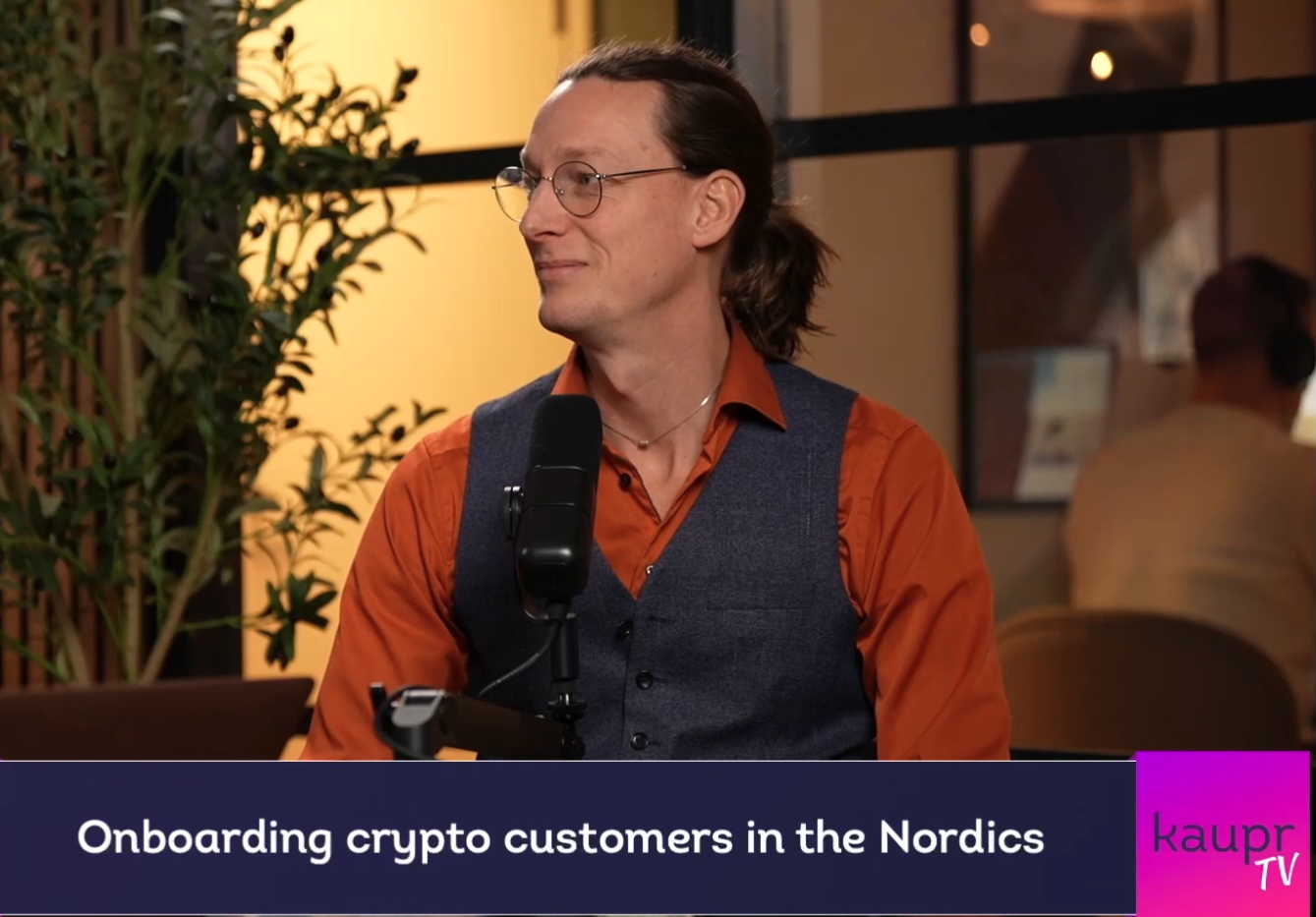
As the first media outlet, Kaupr TV was able to present the news on the last Friday of February just minutes after it was announced in a press release from Goobit. CEO Christian Ander also joined the studio for an open conversation about what the new M&A strategy entails, why the timing is now, and how Goobit and BTCX aim to take a leading role as the Nordic crypto market faces tougher competition, stricter regulation, and potential consolidation.
In the following we reproduce the main points from the conversation, while you can watch the video interview itself by scrolling down the page.
The conversation opens with the fact that Christian Ander was actually going into the studio to talk about onboarding with BankID and bank-to-bank solutions. But right from the start, presenter Morten Myrstad changes tracks. He points to a new message from the company and asks Ander to elaborate on what Goobit and BTCX have announced.
Ander explains that Goobit is now launching a new strategy for the Nordic region, a consolidation and M&A strategy that will strengthen the Nordic crypto market ahead of full MICA implementation. He points out that interest in Sweden and the Nordic region has increased markedly in recent years, and that large international exchanges are also now looking towards the region.
We see a lot of interest in Sweden. Large companies focus on this market and on the Nordic region. Coinbase, Bybit, Binance -- everyone is looking here. And we have been here for almost 15 years, so we have a very unique position in the market,” says Ander.
He adds that Goobit wants to take a more active role in an upcoming consolidation phase, where both acquisitions, mergers and partnerships can be appropriate instruments. According to Ander, the goal is to build stronger Nordic environments, both for private clients, professional investors and institutions.
“We believe the consolidation phase will be led by someone like us, and we are ready to take the first step,” Ander says.
Then comes the question of what this strategy really means in practice. Myrstad asks if Goobit is for sale, whether they are primarily on the buyer side, or whether it is about mergers and other structures - and what kind of models we might see.
Ander replies that this depends entirely on who the counterparty is. He illustrates the point with an example:
It all depends on the partner. If Goldman Sachs comes in and says “hey guys,” then we're not the ones buying Goldman,” he says.
In such a case, it will rather be Goobit that will be purchased. If, on the other hand, there is a more equal partner, such as another crypto company that has been in the market for just as long, it opens up other types of solutions. He also reminds that Goobit is a listed company and that much will therefore depend on how an eventual deal is structured.
On the next point, Myrstad asks directly what drives this strategy — whether it is primarily about costs.
Ander replies that the situation is difficult for most players in the Nordic region.
“No one makes money in the Nordic region, except perhaps for a few players,” he says, warning against a scenario where foreign companies effectively take over the region if the Nordic players do not act.
Ander pulls in MiCA as a clear turning point. The regulations have meant that market participants have to build up more capacity in the regulatory area, and it does not stop there. DORA and new tax and reporting requirements are on the way, and will only increase the pressure further. Thus, it seems more rational to pool operations into fewer, stronger entities, with a common regulatory and technology platform, than for many small ones to bear the costs separately.
Further in the conversation, Ander links this to the competition for the end customer. As more and more players put in place solutions such as Swish and BankID, competition intensifies and fees come under pressure. That's positive for the end user, he stresses, because both increased competition and a more mature, consolidated market structure will provide better and more stable services over time.
“Almost all crypto companies in the Nordic region have red numbers today, and that's not good for anyone. Therefore, this is also a good time to start a more long-term, strategic consolidation,” he says.
Ander would not say who they are talking to, or how far they have come with any of them, but states that the cooperation with K33 is working very well and that they will continue to develop it. K33 is described as a strong partner in Norway, and Ander at the same time draws up his own map of what an ideal Nordic structure could look like: presence in Sweden, Norway and Finland — and, as he adds, “of course Denmark”.
Myrstad is looking forward to GreenMerc as another possible track.
“GreenMerc has previously talked about consolidation and has both Trijo in Sweden and Northcrypto in Finland. Could they also be a candidate in this process? asks Myrstad.
Ander keeps the door open, but stresses that it must make strategic sense. He points out that GreenMerc is already heavily inside Sweden and that the customer portfolios can overlap a lot, and says that it can therefore be interesting to look for partners outside Sweden — and also outside Europe.
Ander points out that several international players have already begun to look towards the Nordic region, mentioning that players such as OKX and Bybit have taken positions in the region — and Coinbase in Europe. He takes this as a sign that the Nordic region is becoming a key gateway to the European crypto market, where global players can test products and market adaptation before scaling more broadly into the EU.
He explains that a granted MICA license would make Goobit a particularly attractive partner for such companies. Once the license is in place, Goobit can act as a regulated platform for players who want to establish themselves in the EU and EEA, but who do not want to build the entire regulatory and technical infrastructure themselves. For Goobit, this means that the company can be both a consolidation engine in the Nordic region and a bridge builder between global players and the European market.
“We have been active for almost 15 years and we have learned a lot during these years. What we have, which newer companies don't have, is operational robustness,” Ander says.
He describes how Goobit has stood through several bear markets and a series of shifts in banks' attitude towards crypto.
“We've been through a lot of bear markets and a lot of changes in the banking system. One year, banks are very pro-Bitcoin or crypto, and the next quarter they're not,” he says.
After talking about strategy and regulation, Myrstad asks the question many in the audience want answered: Christian Ander is known as a Bitcoiner, and the retail part of the business is practically Bitcoin‑only — the simple purchase, sale and storage of Bitcoin.
There's one question I have to ask you, Christian. You are known to be a Bitcoiner, and the retail part of your business is more or less Bitcoin‑only. Do you have to leave that position when you go into mergers with other companies, or what will it be like? asks Myrstad.
Ander answers without hesitation.
That's a good question. There is no “second best”, and Bitcoin is the best. We want to provide the best possible signal-to-noise ratio,” he says.
At the same time, Ander stresses that he must pay attention to customers.
“I have to emphasize the wishes and needs of my clients more than my own convictions. So I'm pretty confident that one day we will offer more than just Bitcoin,” he says.
He recalls that BTCX has actually held other assets in the past.
We've done it before too. We had Ethereum back in the day,” Ander says.
Then he puts the product question into a commercial framework.
It's also a commercial decision. As we grow, other assets will be offered, I'm pretty sure of that,” he says.
Ander also points to stablecoins and tokenization as areas of interest.
“We also have this stablecoin discussion coming up and getting more and more interesting. So it's also a different asset class,” he says.
Furthermore, Ander allows for tokenized assets to come on the table.
“Who knows, depending on our partner, there may be tokenized forms of other assets, such as property, stocks or commodities. I'm not saying we do, but I can see it happening. At some point it will be interesting to have,” Ander says.
Myrstad comments: “We saw the other day that both Coinbase and Kraken offer stock-related products — not tokenized stocks in the case of Coinbase. So will we also be able to see an integration with traditional banks and marketplaces?
Ander confirms that he is talking to banks and that the interest is there, although he is unsure how far they will actually go into crypto.
Towards the end of the conversation, Myrstad asks about the time perspective: Now that Goobit has opened the door and invited both partners and investors in, how long does this window last?
Do you have a time perspective on this? You have opened the door and said that you can invite people to the party — and you can also join someone else's party,” Myrstad says.
Ander replies that the time is now.
'I would say now is the time to act, 'he says.
We are in a kind of crypto winter. It looks like that. We don't know, we don't know the momentum in the market, but it's slowing down,” Ander says.
That is precisely why Ander believes that it is in these phases that one should make the strategic decisions.
“In these phases, when things are slowing down, it's perfect to make strategic decisions like this. So when the next hype comes — we don't know when, maybe until summer, autumn or next year — then we will be ready,” Ander says.
You have read what you can read for free. With an account you get unlimited access to all news and articles on kaupr.io — and become part of the network of investors, professionals and builders following onchain finance.