

The Eurosystem opens Pontes on 21 September, letting tokenised securities on private blockchains settle in central bank money. The service starts small, in euro only and with limited operating hours.
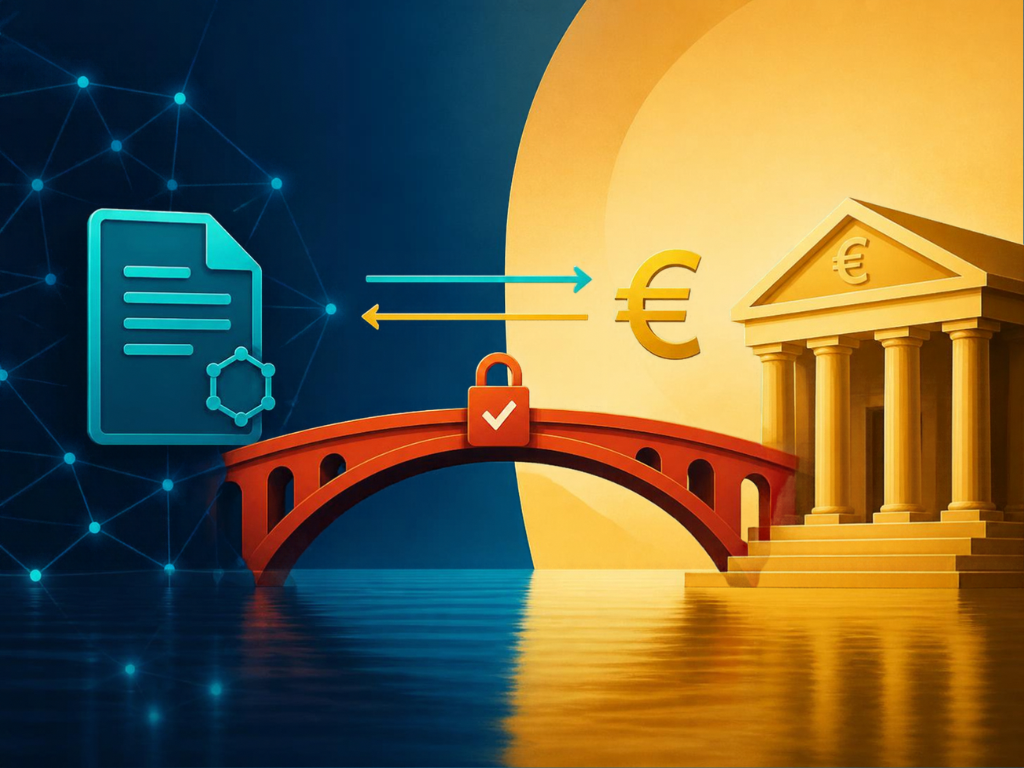
Illustration: AI-generated illustration / Kaupr
Pontes is the Eurosystem's new service for settling tokenised securities, and opens on 21 September. The Eurosystem consists of the ECB and the national central banks of the euro area, and the service is aimed at trading between banks and other financial institutions.
Until now, tokenised bonds have largely settled in two separate tracks. The bond moves on the blockchain, while the money goes through ordinary bank accounts and the two are reconciled afterwards.
Pontes joins the two tracks. Security and payment are exchanged in the same operation, and the payment is made in central bank money. That removes the credit risk on the cash side.
The ECB has dropped the "pilot" label from the project. This is not another trial, but a service in regular operation.
Pontes combines three solutions from the German, French and Italian central banks. They were tested by 64 institutions in the Eurosystem's trials in 2024.
The principle is simple: the security is locked on the market platform until the central bank has confirmed that the payment has gone through. Either both legs settle, or neither does.
The payment itself can happen in two ways. The money can move directly between banks' accounts in T2, the Eurosystem's payment system. Alternatively, the bank can convert money from its T2 account into tokens on the Eurosystem's own closed platform, and redeem them before the day is out.
In the first phase, Pontes is open from 09:00 to 16:00 on business days, and in euro only. Participants pay a one-off fee of EUR 2,500, operators EUR 15,000.
Longer opening hours are planned for 2027. By mid-2028, the goal is round-the-clock operation and more currencies.
Pontes is the short-term track in a plan adopted by the ECB's Governing Council in July 2025. The long-term track, Appia, concerns a more integrated digital capital market in Europe, and has a roadmap of its own.
Any bank with a T2 account can use Pontes for ordinary payments. To pay for a tokenised security, a registered operator has to take legal responsibility for the securities side.
Four operators are registered: Clearstream, SWIAT, Cashlink and Axiology. The Eurosystem sets no requirements as to which blockchain the security sits on, so open blockchains can be used too.
More operators may follow. Those eligible to apply include central securities depositories and banks, subject to an assessment by their national central bank.
Tokenised bonds have been tested in Europe for several years, but volumes remain small. According to the industry body AFME, DLT-based bonds worth EUR 893 million were issued in 2025, down from EUR 1.7 billion the year before.
The absence of central bank money is one explanation. The European Securities and Markets Authority, ESMA, pointed to exactly that in its 2025 review of the EU's DLT pilot regime.
In the US, the same market is growing on private money. Congress is working to block a digital central bank dollar, while stablecoins, crypto tokens with a fixed value against the dollar, have been given rules of their own.
The ECB sees that as a threat. If securities move on-chain without central bank money following them, dollar stablecoins could become Europe's default cash leg. That was the argument made by Isabel Schnabel, member of the ECB's Executive Board, at Jackson Hole in August.
Blockstories asked three of the operators what they expect in the first year. All three point to new bond issuance as what comes first.
Clearstream expects many of the securities to be moved onto ordinary securities accounts right after issuance, because most investors cannot hold securities on-chain.
"It may look like a detour, but it reflects where the market stands today," says Thilo Derenbach of Clearstream.
Cashlink argues that it is the banks, not the infrastructure, that will slow things down. Connecting requires changes to core banking systems, something banks rarely undertake.
"For once the central bank is ahead of the market, and participants have to catch up," says chief operating officer Raphael Neuberger of Cashlink.
SWIAT expects most payments to keep running directly in T2 in the first year, because banks know that system.
"The goal is no longer another pilot, but infrastructure for future transactions," says Sladjan Seferović of SWIAT.
Sources: Blockstories, ECB, PANews
You have read what you can read for free. With an account you get unlimited access to all news and articles on kaupr.io — and become part of the network of investors, professionals and builders following onchain finance.