

DNB director Ole Morten Sunde says collaboration between banks and regulators is essential to solving tokenisation. Large, ongoing projects have already solved a classic challenge: moving bank money directly across banks, central banks and currencies.
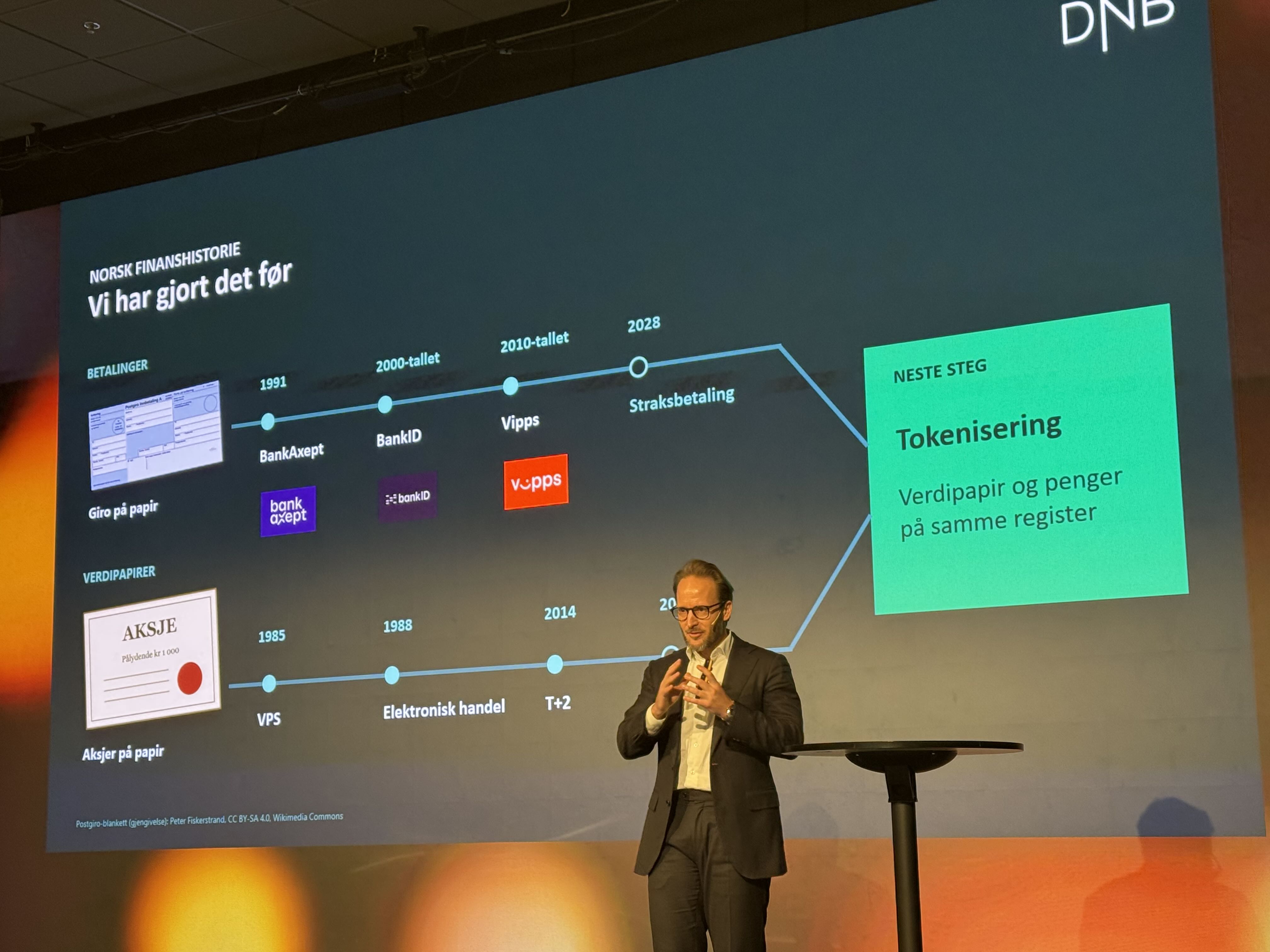
Photo: Ole Morten Sunde (DNB) at Finance Norway's payments and digitalisation conference, with the presentation «We've done this before» in the background.
Ole Morten Sunde, who leads DNB's tokenisation work, spoke at Finance Norway's payments and digitalisation conference. Sunde pointed to two key messages: collaboration between banks and regulators is becoming essential, and that payments and securities – which for decades have belonged to separate value chains – can now meet on the same digital register, built on blockchain technology.
Sunde described today's settlement system as a long table: buyers at one end, sellers at the other, with brokers, banks, a central securities depository and a central bank in between – each keeping its own books that must be reconciled. The system works, but is time-consuming and costly, and next autumn T+1 settlement is introduced in Europe, halving the time. Tokenisation instead turns settlement into a round table: participants share a common register, money and securities settle in the same instant (atomic settlement), and transactions can be programmed as smart contracts – for example, so that money automatically moves when the security is delivered.
Sunde believes the full benefits of tokenisation cannot be realised without bringing in every component and every participant – which is why collaboration between the public and private sectors becomes essential. Sunde stressed that this has been done before.
He drew a historical parallel to 1985, when the banks, brokers and Norges Bank joined forces to establish the Norwegian Central Securities Depository (VPS) and eliminate paper certificates – a collaboration that has since produced solutions such as BankAxept, BankID and Vipps.
DNB, for its part, has chosen to invest expertise and testing in tokenising bank deposits, both in collaboration with Norges Bank and now also through CBMT, Commercial Bank Money Token – a bank-led initiative that originated in the German banking industry, where DNB recently connected Norwegian kroner alongside the euro, dollar and yen. Sunde was clear that CBMT remains a sandbox environment: banks are testing and learning how bank money can be transferred this way, within today's banking rules.
Within the CBMT project, banks are now also looking at how bank money can be built into ERP systems, letting businesses pay directly from them without intermediaries, and at how the same, «smarter» money could be used in agentic payments – where an AI agent executes the payment on a customer's behalf. Both are still early-stage and largely unexplored at scale.
In a panel debate later at the conference, Sunde pointed out that tokenisation of bank money is nonetheless not just theory. Large, ongoing projects have already carried out live transfers of bank money using real money. This has happened across several banks, several central banks and several currencies – not via the SWIFT network, but directly between the participating banks.
According to Sunde, this solves what has been an Achilles' heel for bank deposits compared with stablecoins: that the money is locked in one place. When bank money can move more efficiently across banks and borders, capital is freed up. Volumes increase. He describes it as a «win-win-win scenario» for customers, banks and society.
Sources: DNB
You have read what you can read for free. With an account you get unlimited access to all news and articles on kaupr.io — and become part of the network of investors, professionals and builders following onchain finance.