

From Berlin and Frankfurt to Brussels, political leaders and central bank officials are now speaking increasingly openly about Europe’s dependence on US‑controlled currency and payment systems, as the EU’s digital euro project enters a technical phase ahead of a trial vote in May.
The digital euro is envisioned as an electronic form of central bank money for everyday payments, which is supposed to exist alongside cash and bank deposits, not replace them. As Germany's chancellor last week linked weak euro and export challenges to the need for a stronger currency, central bank tops such as Piero Cipollone and Burkhard Balz used new interviews to stress that Europe needs a more robust, separate payments infrastructure. The project is now entering a technical preparation phase ahead of an expected vote in the EU parliament in May.
German industrial-based export economy is being squeezed by a weaker dollar that has strengthened the euro and made German goods more expensive out there. Merz warns that the combination weak dollar and strong euro is a significant additional burden for manufacturers, particularly for medium-sized firms with small margins and limited opportunities to hedge against currency risk. Export organisations describe the strong euro as a source of great concern for smaller and medium-sized firms already struggling with sluggish growth and tough competition.
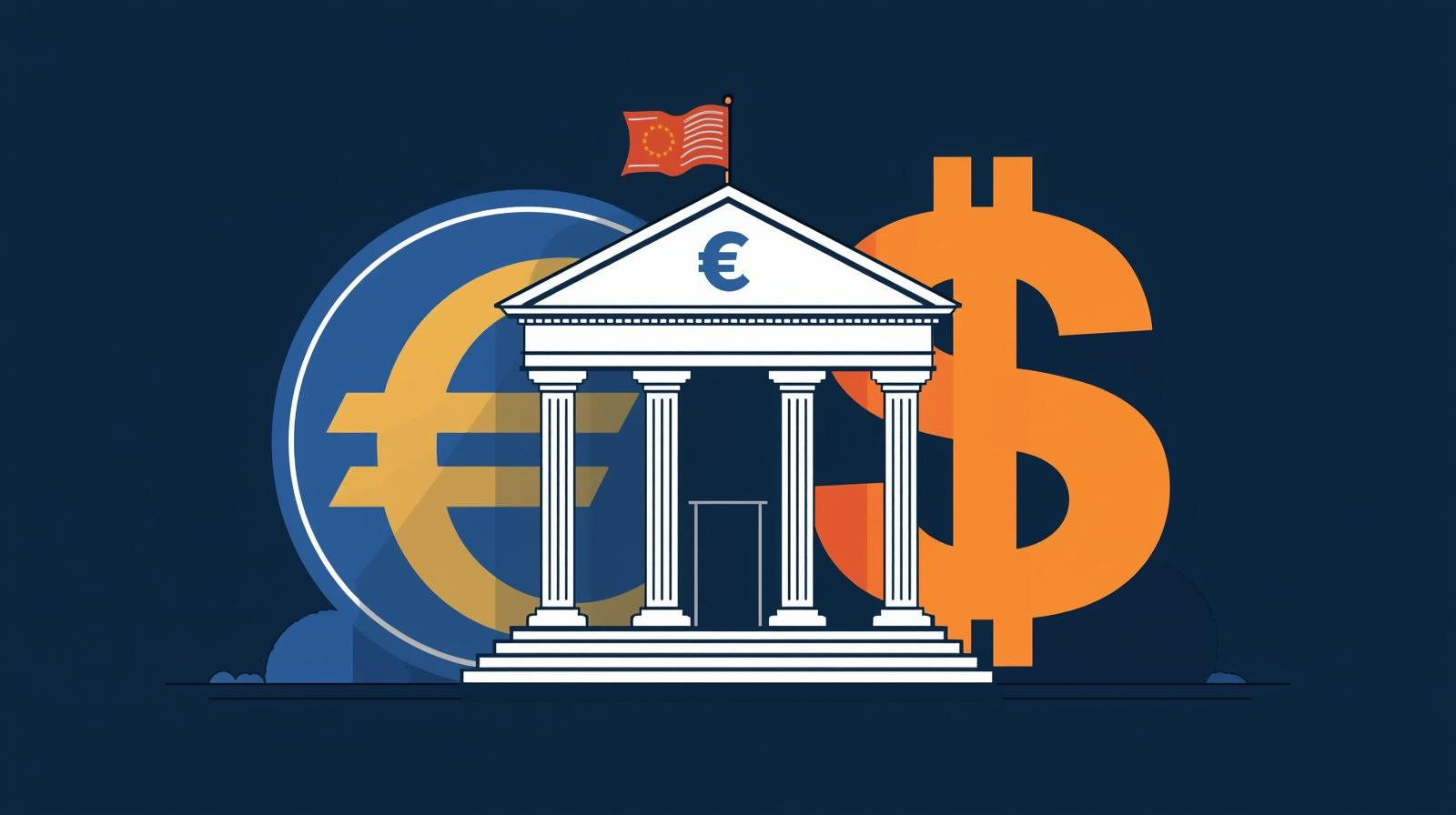
In this image, Merz and German Finance Minister Lars Klingbeil have stepped up their demand for rapid progress for the digital euro. Their point is that, over time, a stronger international role for the euro, side by side with the dollar, could make Europe less vulnerable to U.S. monetary policy shifts and dollar movements -- even if a digital euro is just one tool among several.
The European Central Bank has now finished the initial preparatory phase and entered a phase that deals with technical clarification, market integration and support for lawmakers. The work includes, among other things, a regulatory framework for the scheme, the selection of key service providers and an innovation platform to test applications and interact with other solutions.
German central bank chief Burkhard Balz outlines an internal plan whereby agreement on the legislation by the end of 2026 allows for pilot operation of a retail digital euro from mid-2027, with a possible full launch in 2029. He describes the project as a marathon that has passed the 30-kilometer mark, and that the main focus is now on frameworks such as stock limits, offline payments and the division of roles between central banks and private actors — not the actual yes/no decision on issuance.
Italian central bank chief Piero Cipollone describes the digital euro as much as a response to fragmented payment solutions and changing payment habits as to grand politics. He points to the ECB both providing means of payment and ensuring well-functioning payment systems, and questions whether the current patchwork of solutions actually gives Europeans an easy way to pay digitally across the eurozone without leaning on non-European players. The share of cash in the overall value of daily payments has fallen sharply, while e-commerce now accounts for a significant portion of consumption - an area where physical banknotes and coins do not work.
At the same time, both Cipollone and Balz stress how heavily Europe rests on foreign payment networks. In Germany, PayPal has close to a third of online commerce, while Mastercard, Visa and American Express dominate the card market, and national schemes such as girocard rely on international rails for cross-border use. Cipollone recalls that every conceivable tool is now being used politically, and that sanctions and geopolitical conflicts reinforce the argument for a European payment infrastructure built on European technology under European control.
On the government side, EU countries have agreed on a common position on the Single Currency package, which consists of one regulation on a possible digital euro and one on cash as a compulsory means of payment. It mandates member states to negotiate with the European Parliament and the Commission on final legal text once parliament has adopted its position.
The aim is to prepare the euro for the future, strengthen the EU's strategic autonomy and ensure that both cash and an eventual digital euro can be used effectively throughout the euro area. The Council's position states that a digital euro should be a compulsory means of payment, designed as a supplement to cash and available also offline, while the Cash Regulation tightens the obligation to accept cash in stores and obliges member states to ensure actual access to banknotes and coins.
In the European Parliament, the case is now going through the ECON Committee towards a first plenary vote, probably on 5 May 2026. This vote will define parliament's negotiating mandate and become the first real gauge of political support for a detail‑oriented digital euro.
The debate over a digital euro is now dividing professional communities and commentators in Europe. About 70 European economists, among them Thomas Piketty, have signed a petition asking EU parliamentarians to support a strong public digital euro and warning that otherwise the eurozone risks losing control of the most fundamental component of the economy -- the money -- to foreign private actors and dollar-linked stablecoins. For them, a digital euro is a necessary safeguard of European monetary sovereignty, stability and resilience.
Critics, including in liberal think tanks, point out that the first CBDC trials in countries such as the Bahamas and Jamaica show no clear gains. They argue that Europe's dependence on foreign payments giants is primarily due to its own regulation, and warn that a digital euro could add complexity on top of an already skewed competitive picture without addressing the underlying causes. At the same time, it raises new concerns about government transparency of everyday payments and privacy.

