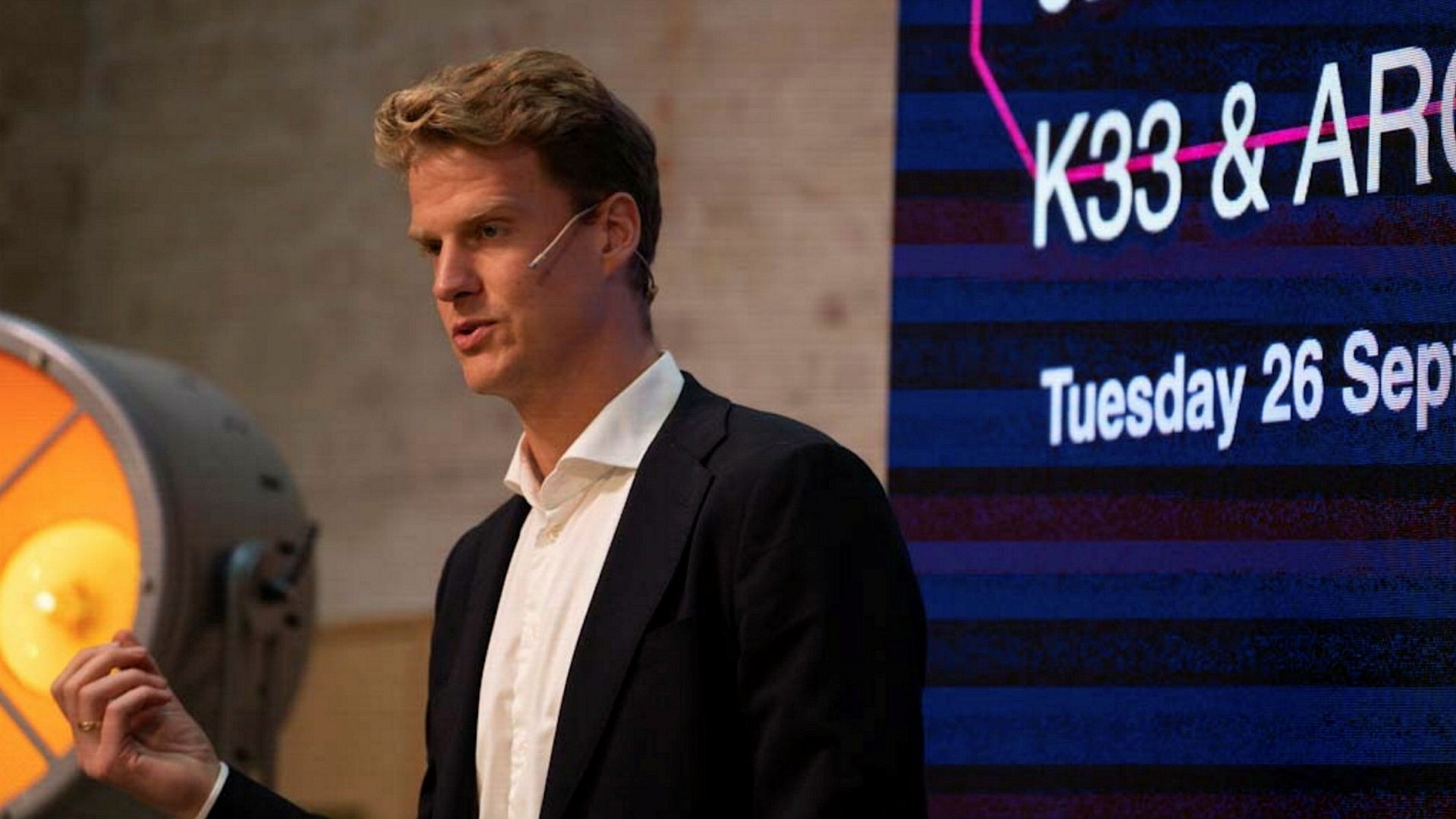
K33 delivers a strong 2025 annual report in line with preliminary figures, but in today’s earnings presentation Torbjørn Bull Jenssen spends most of his time on the Bitcoin strategy – making it clear that K33 is not scaling down, but doubling down

In his presentation, Bull Jenssen describes a “perplexed” market, where bitcoin's price fell sharply and activity dipped towards the end of last year, while institutional adoption and regulatory maturity continue to accelerate.
“Bitcoin is actually in a better position now than when it stood at 120,000. If you liked bitcoin at 120,000, you should like it even more at 66. Relevance of a digital, programmable, censor‑resistant and absolutely scarce monetary unit is more important than ever, Bull Jenssen said.
He points to exploding sovereign debt, inflationary pressures, and rising geopolitical tensions as drivers that over time will favor inflation-hedged and neutral non‐government reserve assets — and sees bitcoin as a candidate to become a future global reserve currency over the next decade.
Bull Jenssen asks investors to ask themselves three questions: whether the world will become more digital, whether the level of conflict will increase, and whether younger generations who already know crypto will inherit power and capital — answering “yes” to all three, he believes that the recent price drop is an opportunity, not a danger signal.
At the same time, K33 stresses that bitcoin holdings should not be a passive speculative item. In the presentation, the company highlights three strategic uses: deploying BTC directly in its exchange and trading operations, supporting lending and liquidity provision, and enhancing flexibility and credibility with customers.
La messaggio se summarized on a slide with the wording “Balance sheet strength directly supports revenue generation,” marking that the Treasury should be used operationally to drive revenue.
In practice, this means that bitcoin exposure is closely linked to products such as crypto‑secured loans, improved liquidity in K33 Markets and new solutions aimed at professional and institutional clients, rather than being a pure price exposure.
This distinguishes K33 from players who have previously built up large but poorly integrated BTC positions on their balance sheets — and who have subsequently had to take heavy write-downs without having had a clear operational use of the holdings.
Several international crypto and fintech companies have in recent years reduced their exposure to bitcoin after heavy losses on their treasury positions or opted to pivot away from the strategy.
K33 is going in the opposite direction: the company has launched crypto‑backed loans, and has agreed to become the largest shareholder in Canadian bitcoin company Sixty Six Capital — a transaction that is planned to significantly increase K33's overall bitcoin exposure.
In today’s report and presentation, this is more clearly linked to the business model: the bitcoin treasury is intended to be a tool for generating revenue through lending, liquidity provision, and new structured solutions for clients – not just a bet on a price increase. At the same time, the unrealized loss on the bitcoin holdings in the fourth quarter illustrates how sensitive the results are to price movements, but Bull Jenssen makes it clear that the price drop does not change the strategy – in his view, it strengthens the argument for continuing to build.
You can watch the recording of the presentation below
You have read what you can read for free. With an account you get unlimited access to all news and articles on kaupr.io — and become part of the network of investors, professionals and builders following onchain finance.