
More than 99 per cent of stablecoins are in dollars. That runs counter to Europe's goal of relying less on US players, says Mads Clemmensen of Danske Bank, a founding member of the Qivalis bank consortium for a euro stablecoin.
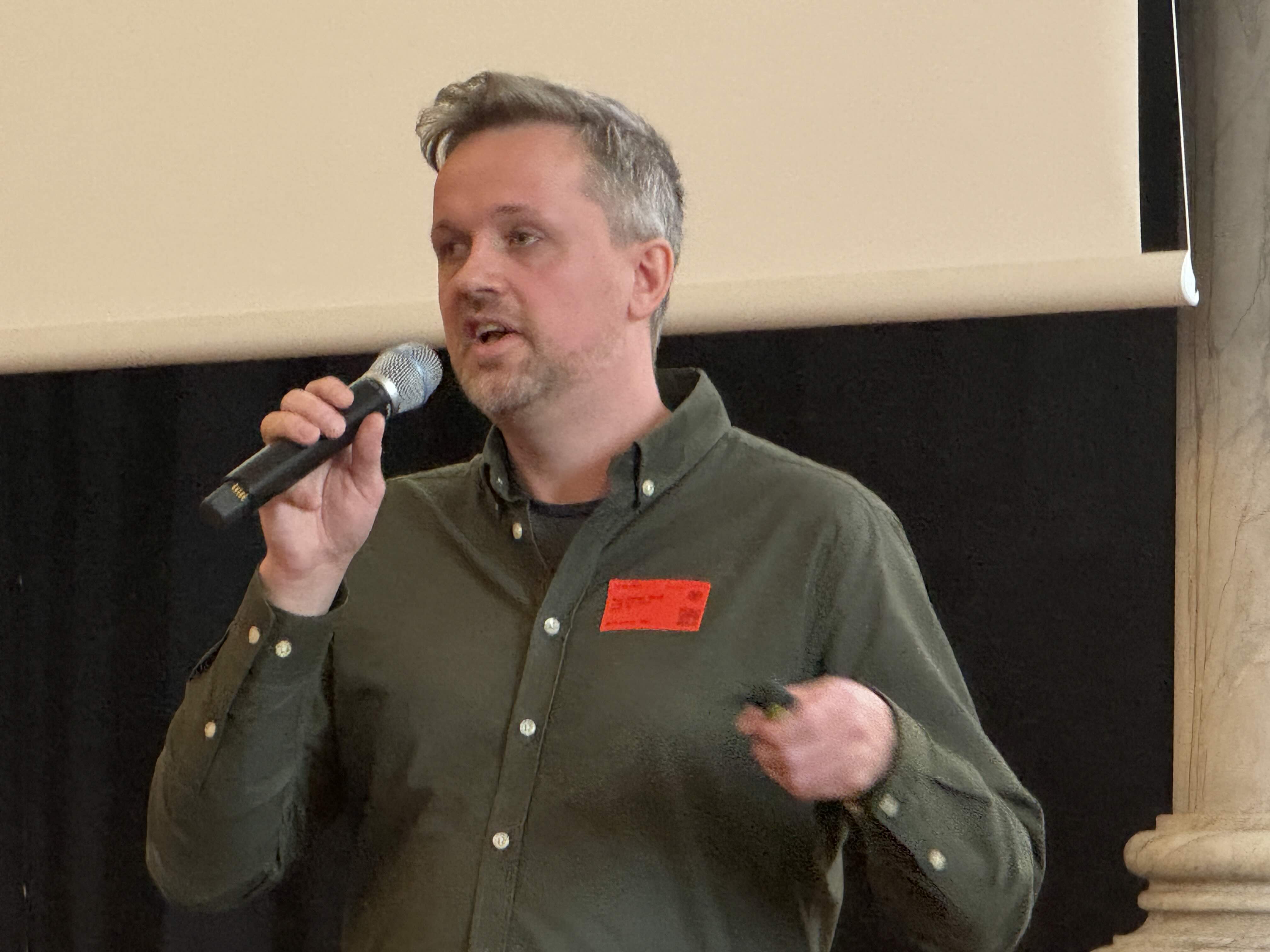
Caption: Mads Clemmensen works on digital assets at Danske Bank.
Mads Clemmensen of Danske Bank said this at Dansk Blockchain Forum, held in the Danish parliament, Folketinget, in Copenhagen in mid-September and organised by Nordic Blockchain Association and Liberal Alliance. It was the second year in a row that a blockchain conference took place inside the Danish parliament, and this year's event drew close to 150 participants. In his talk, Clemmensen confirmed that Qivalis will launch its euro stablecoin before the end of the year, but also said that Danske Bank has a team working on how the bank will put a stablecoin solution to use.
A stablecoin is a digital token on a blockchain whose value is tied to a national currency such as the dollar or the euro. Under the EU's crypto regulation MiCA it is called an e-money token and may only be issued by regulated institutions such as banks. The issuer takes in ordinary money, holds it in reserve and issues a matching amount of tokens, which can be redeemed one for one. Danske Bank was among the nine banks that founded Qivalis last autumn, a consortium set up to issue a euro stablecoin under MiCA. By May the consortium had grown to 37 banks from 15 countries, with members from every Nordic country except Norway.
According to Clemmensen, 99.3 per cent of stablecoins are tied to the US dollar. He points out that the US has made stablecoins a strategic priority through its stablecoin law, the GENIUS Act. The law resembles MiCA in many ways, but rests on entirely different policy objectives, he says.
Dollar stablecoins used around the world reinforce the dollar's role as a reserve currency and in trade and cross-border payments. At the same time, issuers place their reserves in US Treasuries. That gives the US a new group of large buyers of its government debt.
Europe looks different. Here, according to Clemmensen, many small details in the regulation make it harder to operate with stablecoins.
Clemmensen links the dollar's dominance to a goal Europe has long held: reducing its dependence on US players in critical infrastructure. The digital economy is no exception, and the stablecoin market today is a dollar market dominated by US players, he says.
This is what Danske Bank wants to address through Qivalis. The reason for joining a consortium rather than issuing its own stablecoin is that the task is too big for any one bank. Several smaller players have already tried, according to Clemmensen.
"If everyone tries to do this on their own, no one will manage to solve it," he says. According to Clemmensen, Qivalis will launch its euro stablecoin before the end of the year.
Clemmensen draws a line between being a co-owner of the consortium driving the development and how each individual bank puts the solution to use. The launch of Qivalis does not mean a wave of new solutions will immediately appear in Denmark, he says.
Danske Bank is nonetheless under way. The bank is building capacity in the area and has technical infrastructure that allows it to do more. Clemmensen has a team around him working on how the bank will put a stablecoin solution to use.
Clemmensen sees stablecoins above all as a tool for cross-border payments. Today such payments run through correspondent banks, meaning banks that process payments on each other's behalf, each tied to its own local payment systems. According to Clemmensen, seven to ten parties can be involved in a single payment, which can take up to a week and cost around 200 Danish kroner.
With stablecoins, the payment can go directly from sender to recipient, without depending on local systems along the way.
Domestically, stablecoins are less interesting, he says. Danish payment systems work well, and the cost of a payment in Denmark is very low.
Clemmensen is also clear that little is happening in Denmark. Large global banks have spent hundreds of millions building products in the area, while Denmark has few players putting the technology to use, he says.
He regrets that the topic receives so little attention, and wants it higher up the Danish political agenda.
Sources: Mads Clemmensen, Kaupr
You have read what you can read for free. With an account you get unlimited access to all news and articles on kaupr.io — and become part of the network of investors, professionals and builders following onchain finance.