The same day bitcoin fell below $60,000, Torbjørn Bull Jenssen of K33 tells Kaupr that a further fall to $48,000 would not surprise him if the AI bubble bursts. He nonetheless remains a long-term believer in bitcoin.
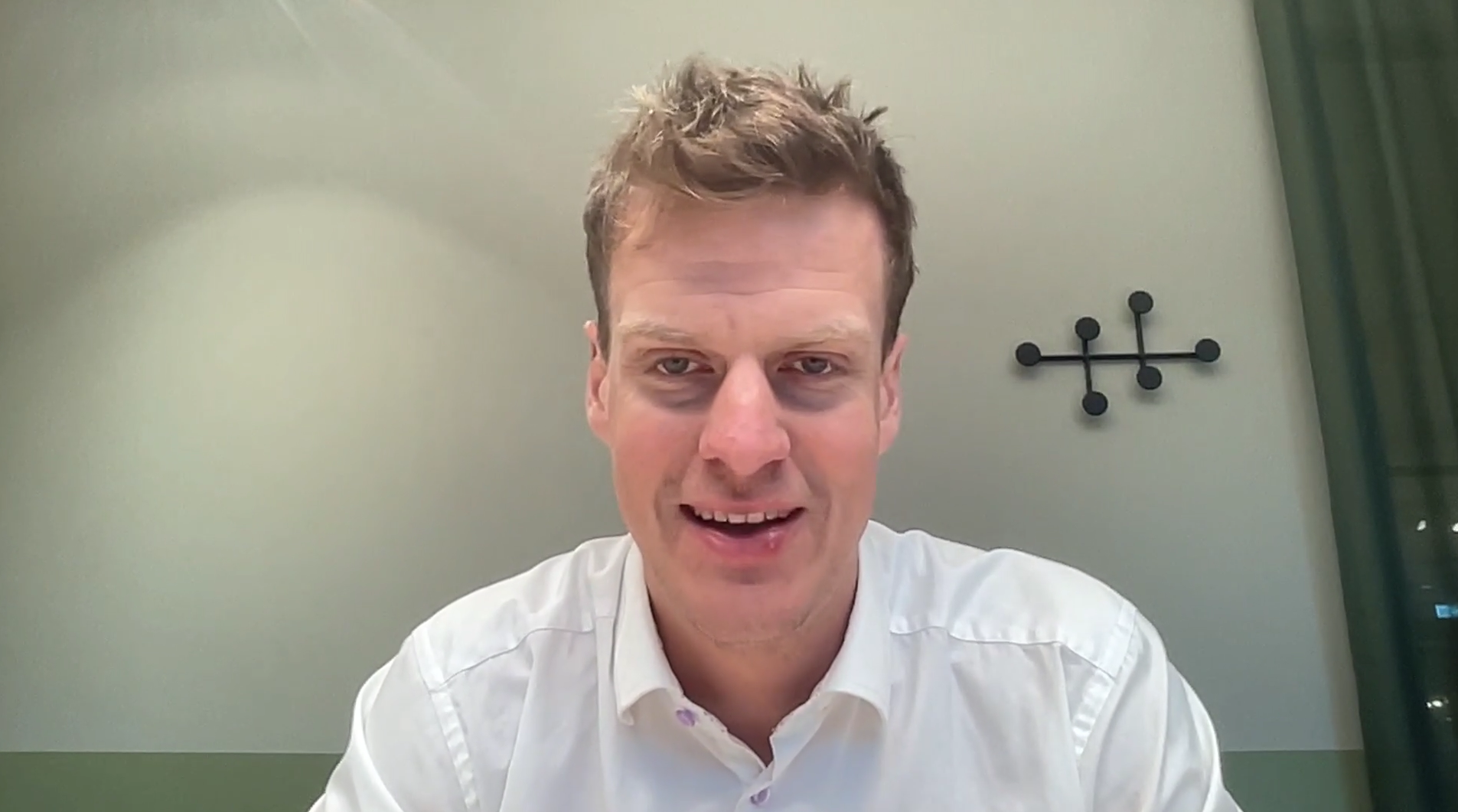
Photo: Torbjørn Bull Jenssen, CEO of K33, interviewed on video by Morten Myrstad.
K33 published its third-quarter results on Thursday morning. The same day, the bitcoin price fell below $60,000, after a week marked by unease in equity markets over a possible AI bubble and falling risk appetite globally. In an interview with Kaupr, chief executive Torbjørn Bull Jenssen put into words how fragile he thinks the market is right now — and why he does not think the bottom has necessarily been reached.
– It's not just that the bitcoin price is relatively low right now, the market is also surprisingly shaky. Bitcoin itself has been fairly robust and promising for almost the whole year, but now we're getting unease from the tech sector, from the question of whether the AI bubble will burst, spilling over into the bitcoin and crypto market, says Torbjørn Bull Jenssen, chief executive of K33.
This week, the research house Galaxy revised down its estimate of where bitcoin could bottom out, from $56,000 to $48,000. Jenssen says he would not be at all shocked if the price fell that far, especially if there is a genuine repricing of AI and tech stocks. He does not know whether that would happen abruptly or gradually, but believes bitcoin itself remains strong, while the market around it is shaky and would not be immune to a further deterioration in risk appetite — in the same way gold has recently been sold off.
– That doesn't mean I'm closing my long position or selling bitcoin to hedge the downside. I have a long time horizon and see nothing that makes me personally bearish on bitcoin. It's the volatility you really have to account for in how you position yourself, says Jenssen.
Jenssen points out that the build-out of stablecoins, new payment rails and the tokenisation of stocks continues through the bear market, just as it always has before. Historically, bitcoin's bottoms have been long and flat, followed by U-shaped recoveries — partly because many investors become disillusioned and stop paying attention. He notes that spot-market trading volumes have fallen sharply through this year's quarters, without any force pushing the price further down: there is no excess leverage that could trigger a cascading effect, but also no momentum or money ready to move in at the first sign of optimism.
According to Jenssen, retail investors are the group most frightened by the downturn, and he does not expect them back any time soon — certainly not before Christmas. K33 instead targets high-net-worth individuals, family offices and institutions. He believes bitcoin has moved from being an almost purely retail market to broader, more institutional participation, even though some of that institutional activity is itself momentum-driven: when funds run into trouble with their AI exposure and need dollars, they often sell the most liquid asset they hold, which is frequently bitcoin, to hedge positions or reduce leverage.
An added source of fear right now is AI-assisted hacking, which together with the Binance hack is making headlines almost daily, well beyond the crypto industry too. Jenssen believes AI makes attacks cheaper by stitching together many small weaknesses into one breach, but that this is also forcing faster security work — the crypto industry, as one of the most targeted, will therefore be among the first to harden its defences. He is sceptical that regulation such as DORA alone solves the problem: Binance was not hacked for lack of DORA, and the $3bn–$6bn fine is a stronger incentive than any regulator could create. K33 therefore works on two tracks — compliance and continuous, real security work — driven by a determination never to risk client money.
– If you think this was just a momentum thing, and that it's AI now, you can obviously give up and move on to something else. But if you, like me and K33, believe this is going to become a key part of the future financial system, the bear market is a gift. An annoying gift, but a great opportunity to build and prepare while the market is quiet, says Jenssen.
Timestamps:
0:00 Opening — Q3 results the same day bitcoin fell below $60,000
0:46 Market is "surprisingly shaky" — AI bubble spillover risk
1:20 "Disillusion" as a bottom signal
2:56 New fear factor: hacking and security
4:58 AI as both attack tool and defence
6:26 Skeptical that DORA/regulation alone solves it
7:56 K33's two tracks: compliance vs. real security
9:01 Galaxy's revised bottom call: 56,000 to maybe 48,000
9:35 "Wouldn't be shocked" by 48,000
10:38 Not closing his long exposure
11:04 Building continues through the bear market
11:56 Historical pattern: long flat bottoms, U-shaped recoveries
12:54 Retail most scared, focus shifts to institutions
14:19 Institutional flows are momentum-driven too
15:35 "The bear market is a gift"
Sources: Kaupr interview with Torbjørn Bull Jenssen, K33
You have read what you can read for free. With an account you get unlimited access to all news and articles on kaupr.io — and become part of the network of investors, professionals and builders following onchain finance.