

Tether and Circle are bringing USDT and USDC to bitcoin, Block lets AI agents pay in bitcoin via x402, and Lightspark and Visa link cards to balances in bitcoin and stablecoins. Bitcoin is being tied more closely to the wider crypto economy.
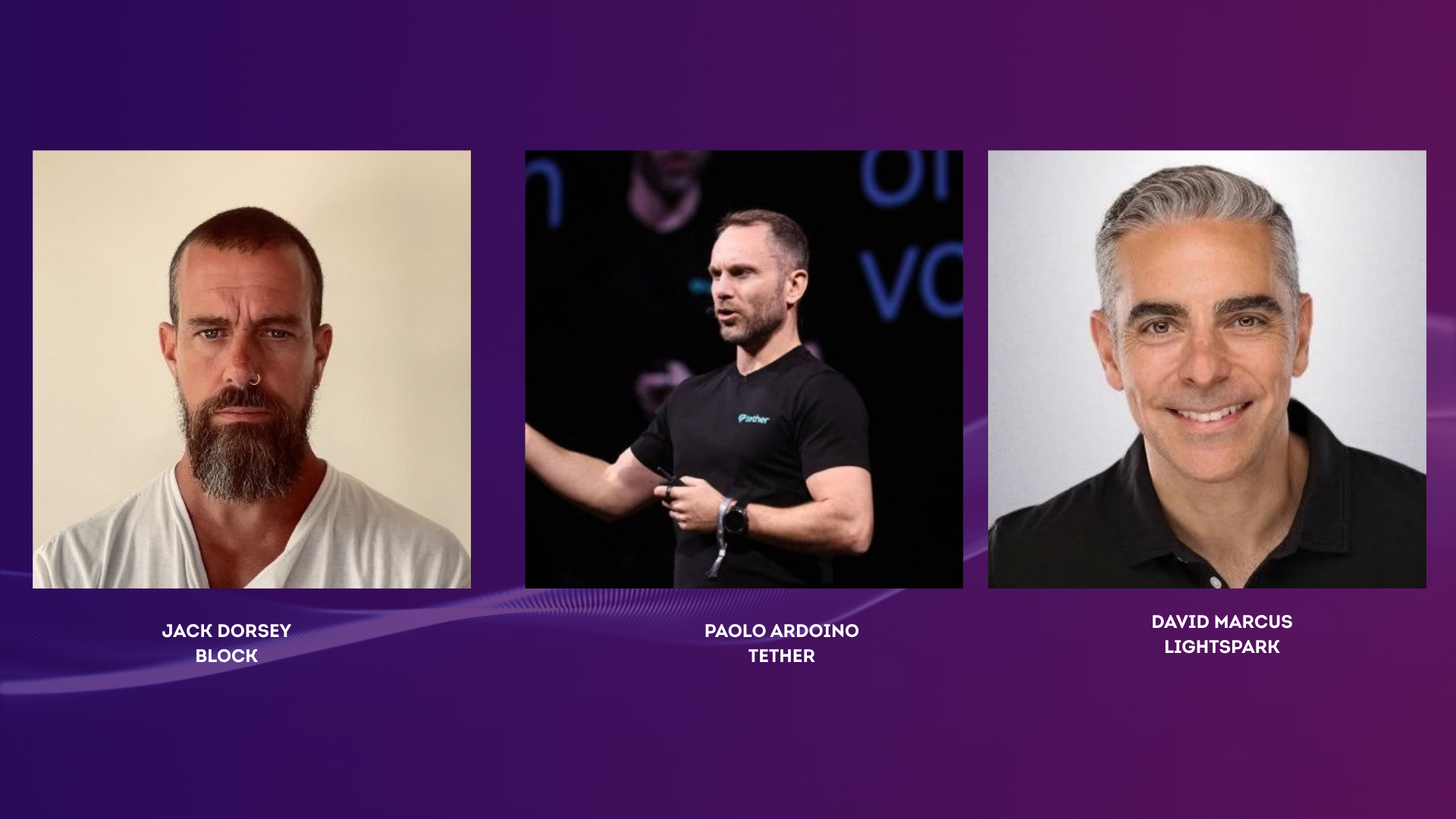
Photo, from left: Jack Dorsey (Block), Paolo Ardoino (Tether), David Marcus (Lightspark)
Bitcoin has long lived a life of its own, while stablecoins – tokens with a fixed value against, for example, the dollar – have mainly been used on other blockchains. Five moves from Tether, Circle, Anchorage Digital, Block and Lightspark are now changing that.
Tether chief executive Paolo Ardoino says USDT, the world's largest stablecoin, is "coming home" to bitcoin. Circle's USDC is also coming to bitcoin, as dollars for loans backed by bitcoin, and Anchorage Digital is opening the way for institutions to earn returns in bitcoin without the bitcoin leaving the blockchain. At the same time, Jack Dorsey's payments company Block, which owns Square and Cash App, has added support for bitcoin payments to x402, an open standard for payments by AI agents. Lightspark, meanwhile, has entered a partnership with Visa on debit cards linked to balances in bitcoin, stablecoins and ordinary currency. Lightning features in three of them. It is a payment network on top of the bitcoin blockchain, designed for fast and cheap small payments.
USDT launched on bitcoin in 2014 through the add-on protocol Omni. It was slow and expensive to use, and most USDT gradually moved to Ethereum and Tron. Tether discontinued the Omni version in 2023.
The new version runs on RGB, a protocol that issues assets on bitcoin but keeps transaction data off the blockchain itself. Combined with Lightning, it means USDT can be sent and received the same way as bitcoin: quickly, cheaply and without the amount being visible on the main chain.
"Bitcoin deserves a stablecoin that feels fully native, lightweight, private and scalable," Ardoino said when the plans were presented in August 2025.
The company developing the technical solution is Utexo. Tether led its US$7.5 million seed round, alongside Big Brain Holdings, Portal Ventures and Franklin Templeton.
In August, Utexo added its RGB and Lightning module to Tether's development kit for self-custodial wallets, where users control their own keys. Wallets using the kit can therefore gain USDT support once the integration is in place.
Utexo chief executive Viktor Ihnatiuk says he has met Morgan Stanley in Washington to discuss USDT on bitcoin, including cooperation on the use of stablecoins in Europe. Morgan Stanley has not announced any formal partnership with Utexo.
The first real test will be the UniSat wallet, which Utexo has named as its next launch partner. UniSat says it has more than one million weekly active users, a figure that has not been audited. Neither company has given a launch date.
Circle, the issuer of USDC, has partnered with Alpen to make the stablecoin and the company's transfer protocol CCTP available on bitcoin. Alpen uses zero-knowledge proofs, a cryptographic method that lets someone prove a transaction is valid without revealing all the data, to offer financial services on bitcoin.
Where Tether is about payments, this is about bitcoin as collateral. Wallets, custodians and financial platforms are to be able to offer loans backed by bitcoin, yield and trading, while the bitcoin stays on the bitcoin blockchain.
Until now, such dollar markets around bitcoin have depended on wrapped or synthetic stablecoins, or on moving bitcoin to other blockchains. That introduces risk in bridges between blockchains, in the contracts behind the wrapped tokens or with intermediaries.
USDC on Alpen is issued by Circle's regulated entities and is the same USDC as on other blockchains. Through CCTP it can move between networks without being wrapped. The service becomes available only when Alpen launches its mainnet, and no date has been given.
Anchorage Digital, which owns the federally regulated crypto bank Anchorage Digital Bank in the US, plans to let institutional clients earn returns on bitcoin via Stacks, a separate network linked to bitcoin. The service is based on a Stacks upgrade called PoX-5.
Bitcoin has no staking in the usual sense, since the network is secured by miners. Here, the bitcoin is locked for a fixed period with a timelock on the bitcoin blockchain itself. It is not moved to other blockchains, wrapped, lent out or handed to third parties, and the owner gets it back when the period ends. Rewards are paid weekly in bitcoin.
Clients are to be able to commit bitcoin to what Anchorage calls a "BTC bond" directly from their account at the bank, which holds the bitcoin in custody throughout. Registration on Stacks, including a paired stake in the network's own token STX, remains the client's responsibility. Anchorage has not said when the service will be available, how large the returns are or where they come from.
"Institutions want to make their Bitcoin productive without compromising on custody or security," says Nathan McCauley, chief executive and co-founder of Anchorage Digital.
Anchorage Digital also has close ties to two of the other players in this development. Tether invested US$100 million in the company in February, and Anchorage Digital Bank issues Tether's US stablecoin USAT. Visa is among its other investors.
x402 lets a server demand payment when an AI agent requests, for example, an API call or a dataset. The standard uses the HTTP 402 status code, "Payment Required". The agent pays and resends the request with proof of payment.
So far, payments on x402 have almost entirely been made in stablecoins. According to Circle, its dollar-pegged USDC accounted for 99.3 per cent of x402 payment volume in the second quarter. With Block's contribution, settlement can instead take place in bitcoin.
Erik Reppel, who created x402 and sits on the protocol's technical steering committee, says the standard is designed so that new payment networks can be added without locking it to any one of them.
x402 was developed by Coinbase and handed over to the Linux Foundation, which in April set up the x402 Foundation to govern the standard independently of any single vendor. The foundation became operational in July with 40 organisations, among them Amazon Web Services, Google, Coinbase, Mastercard, Visa, Stripe, Circle, Ripple and Shopify.
Over the past 30 days, x402 has recorded 75.41 million transactions and US$24.24 million in volume, spread across 94,060 buyers and 22,000 sellers. The figures cover the whole protocol, not Lightning.
Block has not disclosed volume or usage figures for its Lightning integration and has no timeline for bringing it into Square, Cash App or Bitkey.
"Agents are going to make billions of small payments," says Steve Lee, head of Spiral, Block's bitcoin development unit. He argues that such activity requires payment networks designed for frequent, low-cost transactions.
For Block, x402 is the latest step away from a pure bitcoin line. At Bitcoin 2025 in Las Vegas in May 2025, the company launched bitcoin payments on Square terminals via Lightning. Merchants can keep the bitcoin or convert it to ordinary currency instantly, and the aim was to make the service available to all eligible Square sellers during 2026, subject to regulatory approval.
In November 2025, Cash App opened up to stablecoins. Stablecoin deposits are instantly converted to dollars in the user's balance.
In an interview with WIRED in March, Dorsey confirmed that Block will support stablecoins, but made clear that this is because customers want it, not because he has changed his view.
"I don't like that we're going to support stablecoins, but our customers want to use them. I don't think it's wise to go from one gatekeeper to another," he said.
Dorsey still believes that bitcoin, because no single party controls the network, is the best foundation for an open financial protocol.
The linking of bitcoin, stablecoins and ordinary currency is also moving into card payments. In April, Lightspark, led by chief executive David Marcus, entered a partnership with Visa on debit cards linked directly to the cardholder's balance in stablecoins, ordinary currency or bitcoin. The partnership was part of the launch of Lightspark's payments platform Grid Global Accounts at Bitcoin 2026 in Las Vegas, where the company signalled that it no longer wants to be just a bitcoin company.
The cards can be funded with USDC from Circle and other stablecoins on networks including Solana and Base, with bitcoin via Lightning or directly from the bitcoin blockchain, and with currencies such as dollars and euros. The balance can be spent wherever Visa is accepted.
The partnership starts in the US and Europe. Lightspark plans to become a direct member of Visa, starting in Europe, so that it can run card programmes for banks and fintech companies.
"Whether your balance is in fiat, stablecoins or bitcoin, you should be able to spend it anywhere in the world, instantly," Marcus says in the press release.
The next step came in August. The card programme is issued by Lead Bank, processed by card processor Lithic and settled in USDC. The balance is held in stablecoins and converted to local currency at the moment the card is used. The companies have not disclosed volumes or how many markets the cards will launch in.
Lightspark took a further step on 24 September. Marcus wrote on X that the company is working with Visa on a platform for issuing stablecoin-backed cards, and at the same time launched Lightspark Cards Playground. There, companies can set up and test their own card programme, from issuing a Visa debit card to purchases and refunds.
Visa followed up the same evening.
"Amazing to see all of the ways that stablecoins and a new class of enablers have lowered the barrier to entry for developers to issue Visa cards across the world," wrote Cuy Sheffield, head of Visa Crypto Labs, on X.
Sources: Tether, Utexo, Circle, Alpen, Anchorage Digital, Stacks, Block, Lightspark, Visa, Lithic, WIRED, Altcoin Buzz, CoinDesk, crypto.news, The Fintech Times
You have read what you can read for free. With an account you get unlimited access to all news and articles on kaupr.io — and become part of the network of investors, professionals and builders following onchain finance.