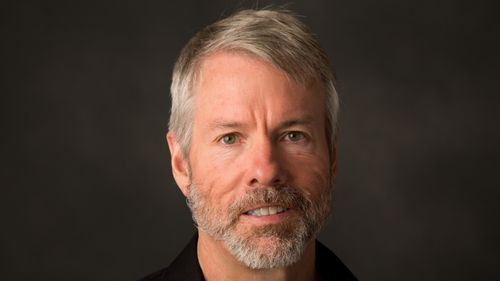
Gustav Buder, Bybit's regional head for the Nordics, argued at the Nordic Blockchain Conference in Stockholm that the existing monetary system is not built for an economy driven by artificial intelligence and robotics – and that bitcoin will prove itself in that transition.
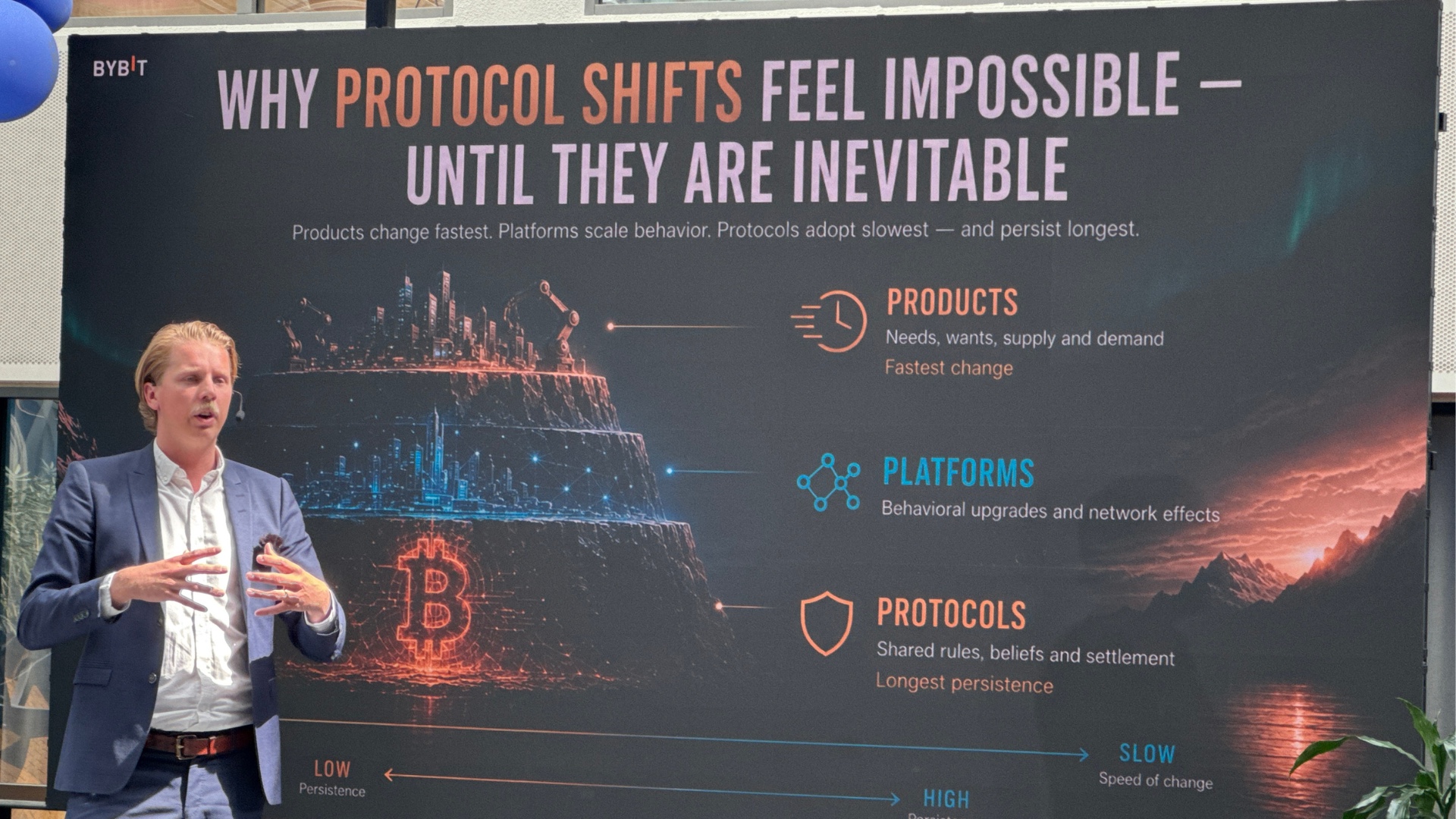
At the Nordic Blockchain Conference in Stockholm on Tuesday, Gustav Buder, Bybit's regional head for the Nordics, painted a picture of a global financial system under pressure. Not from regulators or market volatility, but from a structural incompatibility: a monetary system where debt creates money is colliding with an economy where artificial intelligence and robotics are fundamentally reshaping productivity.
Buder's starting point was straightforward: the existing monetary system is built on money creating money. When the system needs more liquidity, more is printed. That logic has held in an era of limited productivity growth, but Buder argues it breaks down when productivity accelerates sharply.
Faced with an economy driven by AI and robotics, central banks will, according to Buder, do what they have always done: expand the money supply to keep the system running. But that will generate problems that cannot be solved within the same framework.
That is where bitcoin comes in – not as a speculative asset, but as a monetary protocol with a fixed supply and open access. Buder stressed that bitcoin does not require trust in the traditional sense: anyone can connect to it, secure it and use it, without a political committee setting the terms.
His point was that bitcoin does not need to be believed in to prevail. In his view, it is a shift already under way – one that will prove itself against the limitations of the existing system.
Buder used the concept of cognitive dissonance to explain the resistance he encounters. The transition to a new monetary system requires holding two conflicting views of reality at once: the familiar and the new. The reaction – dismissing bitcoin as irrelevant because things have always been this way – is not irrational, but a predictable stage in any shift to a new paradigm.
He urged conference attendees to question their own assumptions, not in order to «believe in» bitcoin, but to consider what a transition would actually mean.
Buder closed by pointing to the Nordics as particularly well positioned to lead the transition. He noted that American fintech players describe the region as a «time machine» – visiting the Nordics is like seeing five to ten years into the future. The foundation is a high level of technological maturity, regulatory openness and a financial system with strong public trust.
Sources: Nordic Blockchain Conference, Stockholm, 27 May 2026, Kaupr
You have read what you can read for free. With an account you get unlimited access to all news and articles on kaupr.io — and become part of the network of investors, professionals and builders following onchain finance.