

With strong backing from Visa, NBX is launching Flexcard, a Visa card that links spending directly to the company's stablecoins. That makes NBX the first stablecoin-linked Visa card in Europe, and likely the second Flex card after Klarna.
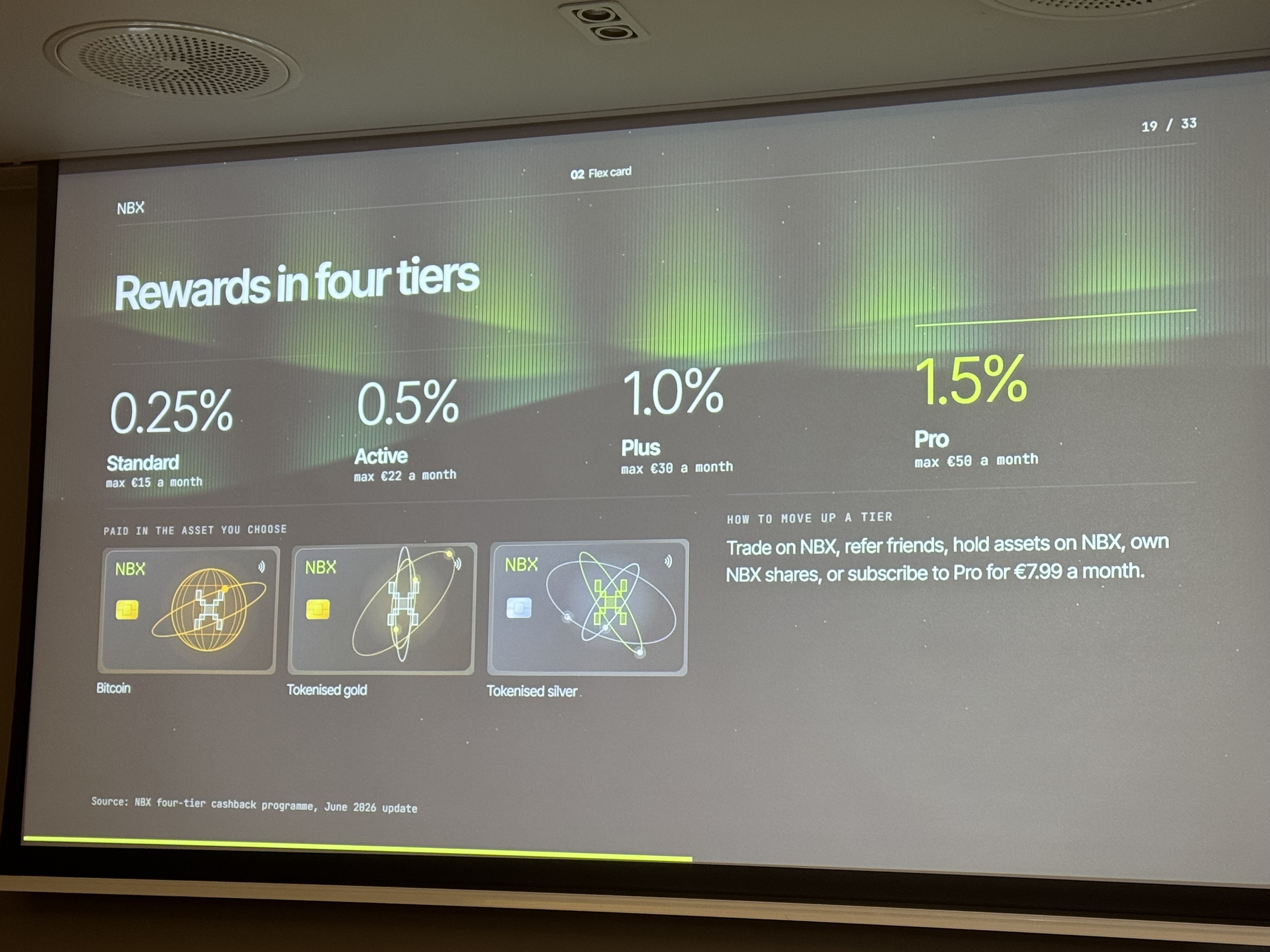
Photo: One of the slides from NBX's investor day on 19 November, where Flexcard was one of the day's main themes. Photo: Kaupr
Visa Flexible Credential is a new card technology from the American payments company, combining debit, credit and prepaid balance in a single card. So far, only Sweden's Klarna has launched a card using the technology in Europe. NBX holds a MiCA licence and an e-money licence passported across the EU/EEA, and is now developing its own card – called Flexcard – on the same technology, linked directly to the company's stablecoin USDM, issued by NBX itself on the Cardano blockchain. Kaupr first saw the card when chief executive Stig Aleksander Kjos-Mathisen presented it at the company's investor day on 19 November. On Thursday 26 November, Visa issued a press release officially confirming the partnership, with its own quote from Mathieu Altwegg, Head of Product & Solutions, Europe, at Visa.
Visa Flexible Credential lets a single physical or digital card switch between several different funding sources, depending on rules the user sets up. A transaction can be routed to the right account based on where the purchase takes place, which currency is involved, or the type of shop, identified through a merchant category code (MCC). "This is different from multi-currency cards such as Revolut's, which are multi-currency but not multi-account," says Kjos-Mathisen. With Flexcard, a couple could, for example, share one account for joint expenses such as groceries and streaming subscriptions, while personal purchases are automatically routed to each person's own account.
Kjos-Mathisen says Flexcard will likely be the second card in Europe based on Visa Flexible Credential, after Klarna launched its version. Klarna uses the technology for a buy-now-pay-later function, where a purchase is automatically routed to an unsecured credit line. NBX is instead targeting stablecoins as a funding source – something Kjos-Mathisen says no one else has done before.
The link isn't only Kjos-Mathisen's own assessment: towards the end of October, Visa asked for NBX's approval to mention the partnership on its quarterly earnings call to investors. Visa's chief executive stated on the call that the company would "soon, with NBX, launch the first Visa Flexible Credential card linked to stablecoin in Europe."
The card will launch first in a simpler version, with multi-currency and multi-account functionality planned to be ready before summer, according to Kjos-Mathisen. Whether credit is available from the start depends on whether NBX's own bank in Latvia is ready by then – if not, the company will need an external credit partner in the meantime.
Kjos-Mathisen compares the card to the first Tesla: just as the car gained new functionality through software updates after it was sold, Flexcard will keep being developed with new features after launch, rather than being a finished product on the day the customer receives it.
According to Visa's press release, Flexcard will launch first as a debit card in Norway, Sweden, Denmark, Finland and Germany, with Poland next once card issuer IDT Finance completes its own licence passporting there. At the investor day, Kjos-Mathisen also mentioned Lithuania and Latvia as planned markets – these were not repeated in the press release.
Flexcard will have a four-tier loyalty programme, where customers climb levels based on trading volume, total holdings of assets on the platform, subscriptions and ownership of NBX shares. New this time is that gold and silver have been added as a reward form, alongside crypto assets.
NBX is also looking at linking gold savings in the loyalty programme directly to pension savings, so that what today sits as gold in an NBX account could instead go straight into a pension account. "That extends the customer relationship to last for as long as the customer lives," says Kjos-Mathisen.
Around Flexcard, NBX has put together a set of partners: NBX itself is the programme manager, Tieto is the processor and provides the same core banking system used for the upcoming digital asset bank in Latvia, IDT Finance – operating as Justcards (Europe) Limited, authorised by Malta's financial regulator, the MFSA – is the card issuer (BIN sponsor), and Visa supplies the card technology itself.
NBX earns revenue from the card through interbank fees (interchange), currency exchange fees, interest on stablecoin balances linked to the card, and subscription revenue. On the cost side are customer cashback and processing and issuer fees paid to partners.
Sources: NBX, VISA, Kaupr
You have read what you can read for free. With an account you get unlimited access to all news and articles on kaupr.io — and become part of the network of investors, professionals and builders following onchain finance.