

The Lithuanian fintech company Axiology has raised €5 million in seed funding to scale its DLT‑based trading and settlement infrastructure under the EU pilot regime – as the first operator in the Baltics and Nordics, and only the second in the EU with this type of licence.
The question of “fintech 2.0 from the Baltics” is not about yet another payment app, but about companies building the very foundations of capital markets. Lithuanian fintech company Axiology is one of these: The company uses distributed ledger technology (DLT) — a shared digital ledger where multiple players view the same, up-to-date transaction log — to bring together the issuance, trading, settlement and custody of securities in one regulated system. The ambition is to test whether a Baltic player can deliver next-generation market infrastructure for the whole EU, not just new user surfaces on top of a fragmented and old system.
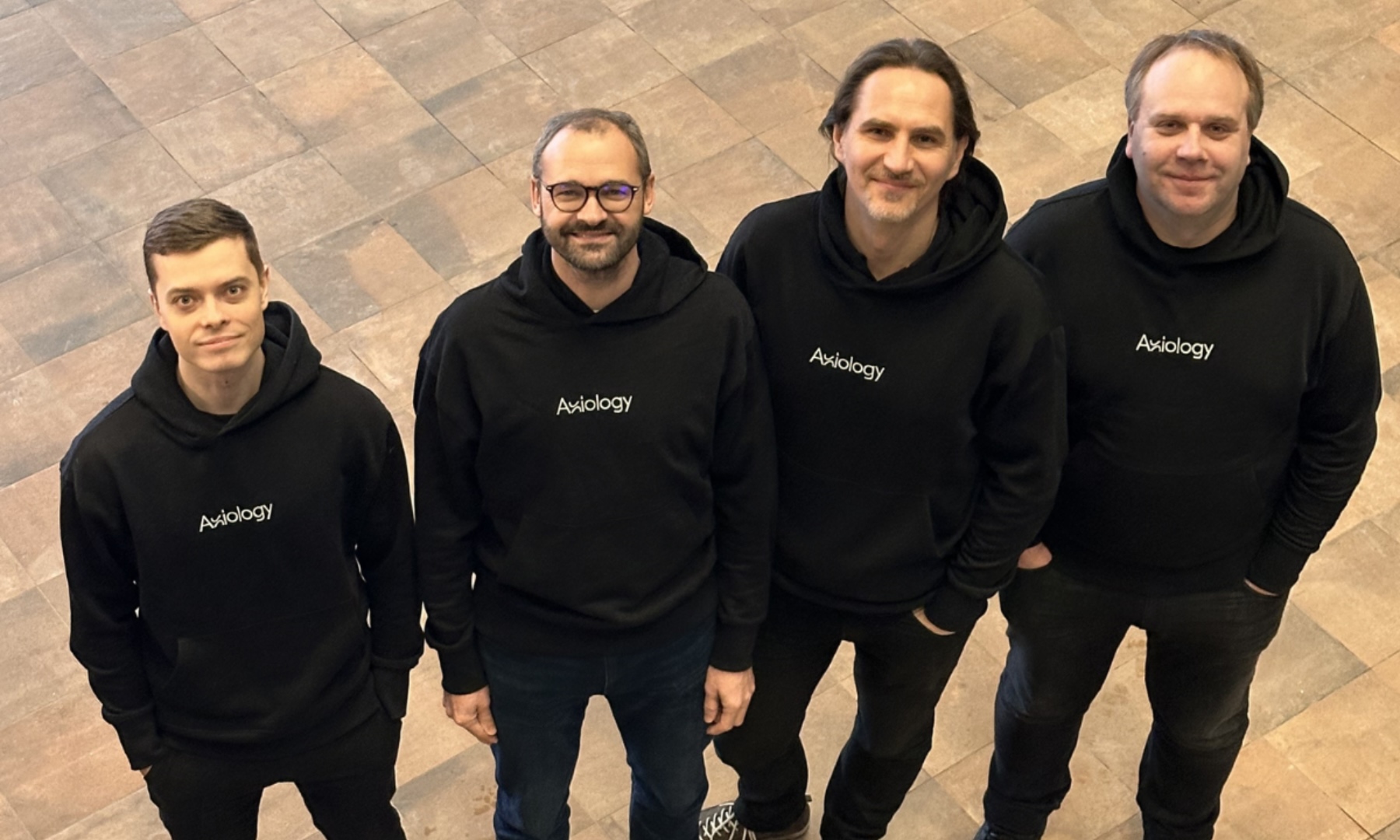
Axiology is established by the entrepreneurs (photo f.v.) Andrius Košuba, Andrius Mamontovas, Marius Jurgilas and Algirdas Neciunskas.
The €5 million SEED round is led by Exponential Science, e2vc and Coinvest Capital, with participation from new investors such as TIBAS Ventures and Plug and Play, as well as existing owners such as BSV Ventures and NGL Ventures. In total, Axiology has now raised around EUR 7 million for its investment in tokenized securities and new market infrastructure. The capital will be used to scale what is described as an already operational system and to execute the go‑to‑market strategy against institutional clients, brokers and other intermediaries. Investors emphasize that Axiology can manage the entire lifecycle of digital interest rate instruments in one regulated environment, as a possible response to fragmented and costly capital markets in Europe.
Axiology is authorised as a DLT Trading and Settlement System (DLT‑TSS) under the EU DLT pilot regime and can thus combine trading and settlement on distributed ledgers within a regulated framework. The license has been granted by the Central Bank of Lithuania in cooperation with the ECB and ESMA, making Axiology the first player in the Baltic and Nordic countries — and only the second in the European Union — with this type of approval. It places the company in a small group of infrastructure companies that get to test new models for trading and settlement of tokenized securities under the EU regime. According to the press release, the infrastructure should make it possible to bring together issuance, depository, trade and settlement in one system, reduce dependence on intermediaries and lower operational costs for users.
One of the most concrete projects Axiology highlights is the collaboration with the Lithuanian Ministry of Finance on a digital-native version of the country's Government Defence Bonds. Today, such bonds are distributed via local financial institutions, limiting their reach to domestic investors. With Axiology's infrastructure, the bonds can be issued as tokenized securities and made available to investors throughout the EEA, including Lithuanians residing abroad. The company cites this as an example of how tokenization can be used to expand the investor circle for government bonds and build a broader funding base for national defense.
Axiology went into operational operation in the fall of 2025 and has launched three main services: a securities depository, a shareholder register and a Multilateral Trading Facility (MTF). The Depot service is already used by crowdfunding platforms, which, via Axiology's system, can structure loan instruments such as bonds and make them available to investors. The shareholder register is in production in Lithuania, with more than 21 million euros in shares registered, and the company plans to take the service to more European markets. The MTF is built into the same trading and settlement infrastructure, and brokers who are already connected should contribute to activity from day one, according to the company.
The Baltic countries have in recent years established themselves as one of the EU's most active regions for fintech, driven by regulatory facilitation and access to capital for early-stage growth companies. Axiology's acquisition of a key DLT license and raising new growth capital makes Axiology an example of a possible “fintech 2.0” phase in which the Baltic region not only delivers consumer-facing financial products, but infrastructure that other European players can connect to. If pilots like the defense bonds and new digital bond runs actually scale into ordinal operations, the region could move from being a regulatory sandbox to an exporter of market infrastructure for tokenized securities.
Designed for institutional users, the system runs on a private, permission-managed network built on a permissioned version of the XRP Ledger (XRPL), with an emphasis on regulatory compliance, transaction finality and verifiable logs. Axiology states that regulated European stablecoins are used for so-called atomic settlement, to enable close to immediate transactions compared to traditional T+2 cycles in the securities market. Strategically, the company points to plans to link to TARGET2 and participation in digital central bank money pilots, such as the ECB's Appia and Pontes initiatives, to be close to possible future central bank money settlement models. Whether Axiology gains a lasting position in European capital markets will depend on both regulatory choices in the EU and actual demand for tokenized securities from states, companies and institutional investors.
You have read what you can read for free. With an account you get unlimited access to all news and articles on kaupr.io — and become part of the network of investors, professionals and builders following onchain finance.