
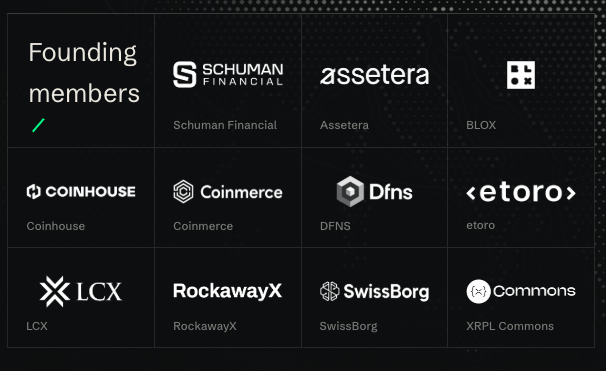
Eurøpe Consortium brings together eToro, Schuman Financial and nine other firms to get euro stablecoins into practical use. Its first programme centres on EURØP. The dollar accounts for 99 per cent of the stablecoin market, the euro for under one.
Stablecoins are digital money on a blockchain that holds a fixed value against a currency, and they have become a core means of payment and settlement in digital-asset markets. Almost all of that market is in dollars.
The EU's MiCA regulation has given euro stablecoins clear rules, but regulation does not create distribution, liquidity and everyday use. That is the problem the Eurøpe Consortium, launched in Paris on 5 October, says it will address — with a stablecoin that is already issued and regulated, not one awaiting launch.
"The EU established a regulatory framework for euro-denominated stablecoins, but regulation alone does not create a functioning market. Adoption requires issuers, distribution platforms, infrastructure providers and broader financial and blockchain ecosystems to work together."
Martin Bruncko, founder and chief executive of Schuman Financial.
Roughly 99 per cent of stablecoin market value is in dollars, according to the European Central Bank's Financial Stability Review from November 2025. Euro stablecoins make up less than one per cent.
The consortium describes the imbalance as self-reinforcing: the currency used most for payments, trading and treasury operations attracts further integrations, infrastructure and users. The result may be that European businesses increasingly use dollar-based infrastructure onchain, even when the underlying activity begins and ends in euros.
"Onchain, the dollar outweighs the euro more than 300 to one, which makes little sense for the world's second reserve currency, which accounts for 20 per cent of global FX reserves," says Viktor Fischer, founder and chief executive of RockawayX, an investor in Schuman Financial.
He expects the next couple of years to be a race to build euro liquidity and distribution now that MiCA is in force.
The consortium describes itself as industry-led, and the eleven firms are referred to as founding members. Schuman Financial is the issuer. SwissBorg, Coinhouse, Coinmerce, LCX and BLOX provide trading and distribution to European customers.
eToro, listed on Nasdaq, brings a global investment platform and distribution to retail investors. Assetera links the euro token to tokenised assets and institutional market solutions, while XRPL Commons connects the initiative to developers and applications on the XRP Ledger.
RockawayX contributes capital and industry relationships. DFNS provides the infrastructure businesses use to hold and move digital assets, and was selected by Schuman Financial in July as infrastructure for issuance and distribution of EURØP.
"As more finance moves onchain, the euro's role should reflect its strength in the global economy," says Ouriel Ohayon, head of crypto at eToro.
Jaap de Bruijn, chief executive of Coinmerce, says its customers trade, spend and save in euros, and that it makes no sense for the onchain world to force them into dollars.
EURØP is an e-money token under MiCA, issued by Schuman Financial. The company is an electronic-money institution authorised by France's ACPR, with the right to operate across the EU/EEA.
The token is backed one to one by euro reserves and high-quality liquid assets held at Société Générale and other named credit institutions, with quarterly attestations by KPMG.
It is available on six public blockchains — Ethereum, Polygon, Avalanche, Solana, the XRP Ledger and Plasma — and trades on Kraken, Bitvavo, Bit2Me, SwissBorg and Bitpanda, among others. EURØP worth 116.8 million euros has been transferred over the past thirty days.
Participants will coordinate in four areas. The first is access and distribution, meaning making regulated euro stablecoins available on the platforms Europeans already use. The second is infrastructure and integrations, covering wallets, trading platforms, tokenised-asset infrastructure and blockchain networks.
The third is practical applications for retail, institutions, payments and tokenised markets, and the fourth is market development through education, communication and engagement with prospective participants.
Each participant retains responsibility for its own commercial, technical and regulatory decisions and contributes according to its role — whether listing, integration, distribution, infrastructure or ecosystem development.
The consortium stresses that membership in itself implies no commitment to list, integrate or provide liquidity for EURØP. Specific initiatives are agreed with the firms involved.
The consortium also intends to bring in more participants, and on the Eurøpe Consortium website invites banks, payment service providers, asset managers, fintech companies and crypto-asset service providers, among others, to apply for membership.
Sources: Eurøpe Consortium, Coinmerce, DFNS, Finextra, Coindar
You have read what you can read for free. With an account you get unlimited access to all news and articles on kaupr.io — and become part of the network of investors, professionals and builders following onchain finance.